Alternatives
Namespace alternatives for GitHub Actions runners
Namespace offers fast runners on hardware it operates, with cache volumes and egress policies. Teams look at alternatives when they want a record of what each build used, or different pricing.
Updated
We build CRACI, so weigh that in; we describe every option from its own documentation and say when another tool fits better.
Why teams look beyond Namespace
Namespace (namespace.so) runs Linux, Windows and macOS runners on hardware it operates itself, selected through runner profiles. Cache volumes keep data on local storage across runs, and its egress policies run in block mode or in advisory mode, which records decisions without blocking.
Teams look elsewhere when their situation changes:
- Evidence. Namespace does not record an SBOM of what each job fetched.
- Price. As of September 2026, a 2 vCPU, 4 GB Linux runner costs $0.002 per minute in plan and $0.003 in overage, with a one-minute minimum.
- Consolidation. Teams that also want build evidence end up adding another tool next to the runner.
What to look for
- Price per vCPU-minute, memory per vCPU, and how usage is rounded.
- Operating systems and architectures you need, including ARM64.
- Dependency and Docker layer caching.
- Egress control, and whether it is a policy on the job or network plumbing you maintain.
- Build evidence: SBOMs, provenance and a record of what each job fetched.
- Where runners live: hosted, in your cloud account, or on your hardware.
The options
1. CRACI (our product)
CRACI is a GitHub Actions-compatible runner built around supply chain security, and it runs builds about twice as fast as GitHub-hosted runners. Install the CRACI GitHub App and set runs-on: craci. Billing is $0.002 per vCPU-minute ($0.004 for a default 2 vCPU runner), metered per second, with no monthly fee and no per-SBOM charge. ARM64 is billed at the same rate (ARM64 capacity is limited). Sizes run from 1 to 32 compute units of 1 vCPU and 3 GB of RAM. Each job produces an SBOM of what it fetched, with a completeness state, runs under an egress policy that fails closed, and records provenance data that the API returns.
Best for: Linux builds of software you ship, where you need to show what went into each release.
Consider if: evidence and egress control matter as much as cost. CRACI is Linux only today (Windows and macOS are on the roadmap) and has no free tier.
CRACI vs GitHub-hosted runners
2. Blacksmith
Blacksmith runs GitHub Actions jobs in Firecracker microVMs, with Ubuntu on x64 and ARM from 2 to 32 vCPU, Windows in public beta, and macOS on Apple M4. It says its runners are twice as fast as GitHub-hosted runners. A colocated cache works with the standard cache actions, and sticky disks provide Docker layer caching at $0.50 per GB per month. As of September 2026, 2 vCPU x64 costs $0.004 per minute and ARM $0.0025, with 3,000 free minutes a month.
Best for: faster, cheaper Actions with Docker caching and SSH debugging.
3. Depot
Depot offers Linux runners from 2 to 64 vCPUs, Windows, and macOS on the Startup plan and above, wired into a distributed cache. It describes its runners as "up to 3x faster than a GitHub-hosted runner." Its remote Docker build service keeps a persistent layer cache, Linux runners support egress filtering, and on the Business plan runners can live in your own AWS account. As of September 2026, 2 vCPU costs $0.006 per minute beyond plan minutes, tracked per second.
Best for: teams whose CI time is dominated by Docker image builds.
Consider if: you want remote build caching for Bazel, Gradle or Turborepo too.
4. WarpBuild
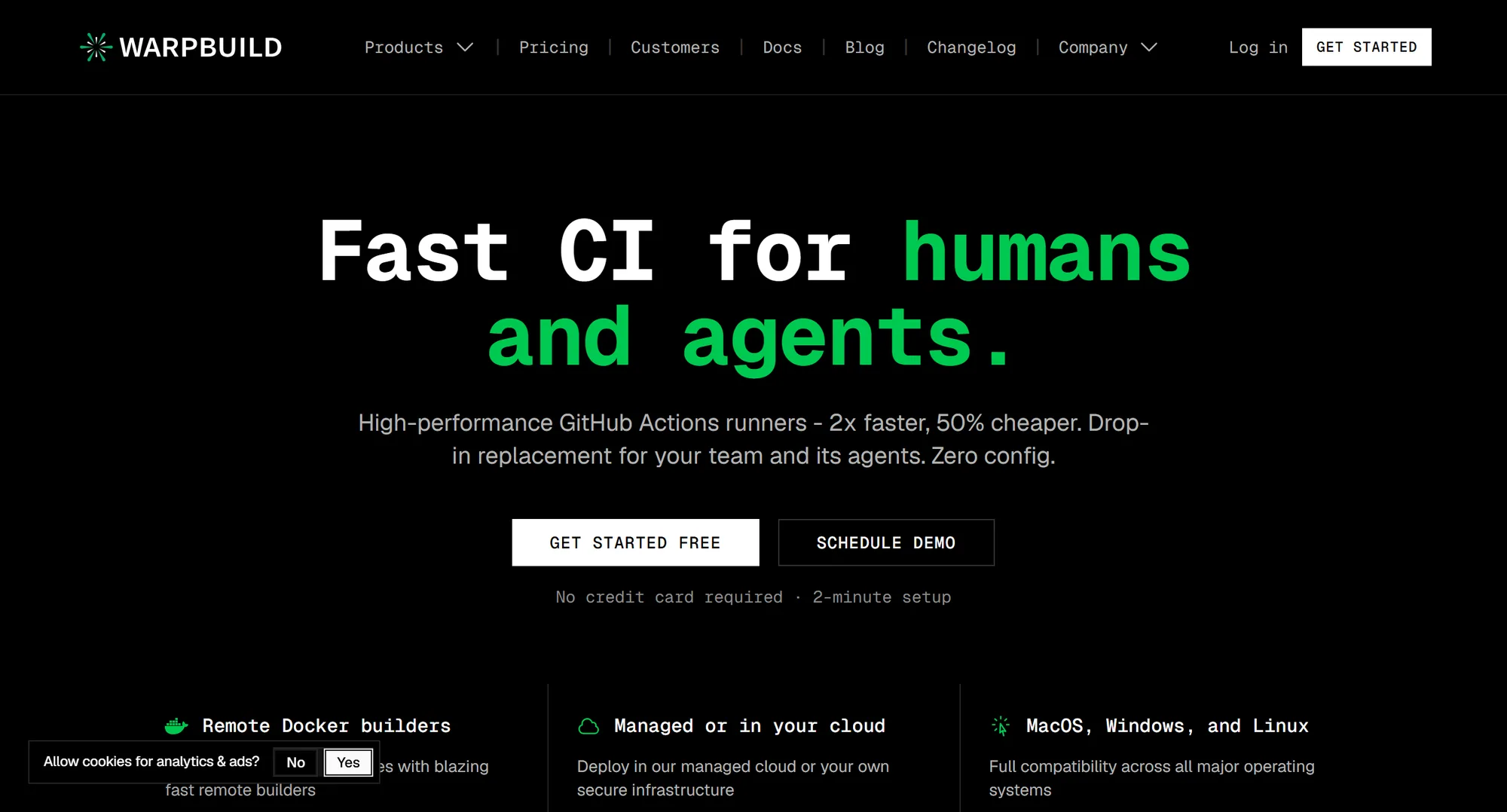
WarpBuild offers Linux runners on x86-64 and arm64 up to 32 vCPUs, Windows Server, and macOS on Apple M4 Pro, with container-layer caching and snapshot runners. Its bring-your-own-cloud option runs the same runners in your AWS, GCP or Azure account at $0.002 per minute plus your cloud bill. Hosted 2 vCPU x86-64 costs $0.004 per minute (as of September 2026). WarpBuild advertises builds two to ten times faster.
Best for: managed runners inside your own cloud account.
Consider if: you need GitHub Enterprise Server support or a 99.9% uptime SLA.
5. Ubicloud
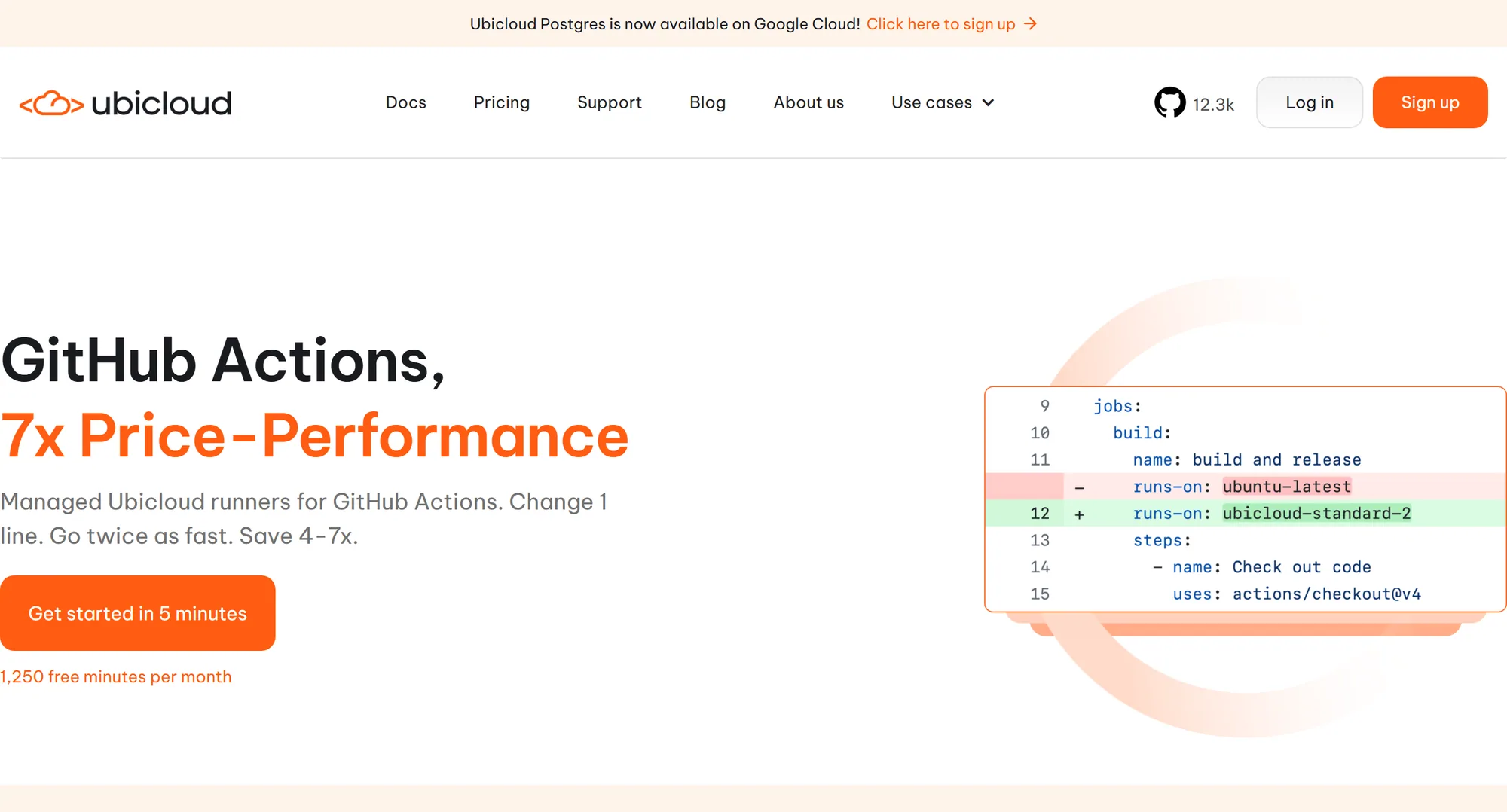
Ubicloud is an open source cloud, and its managed GitHub Actions runners switch over with one label, such as ubicloud-standard-2. It offers Ubuntu runners on x64 and arm64 from 2 to 30 vCPUs. As of September 2026, 2 vCPU costs $0.00125 per minute on x64 and on arm64, billed by the minute, and every account gets a $2.50 monthly credit, about 1,250 minutes. Ubicloud also lets you manage your own runners.
Best for: a low per-minute price for Linux jobs on hosted runners.
Consider if: you only need Linux. Ubicloud's runner documentation lists Ubuntu images only.
6. RunsOn
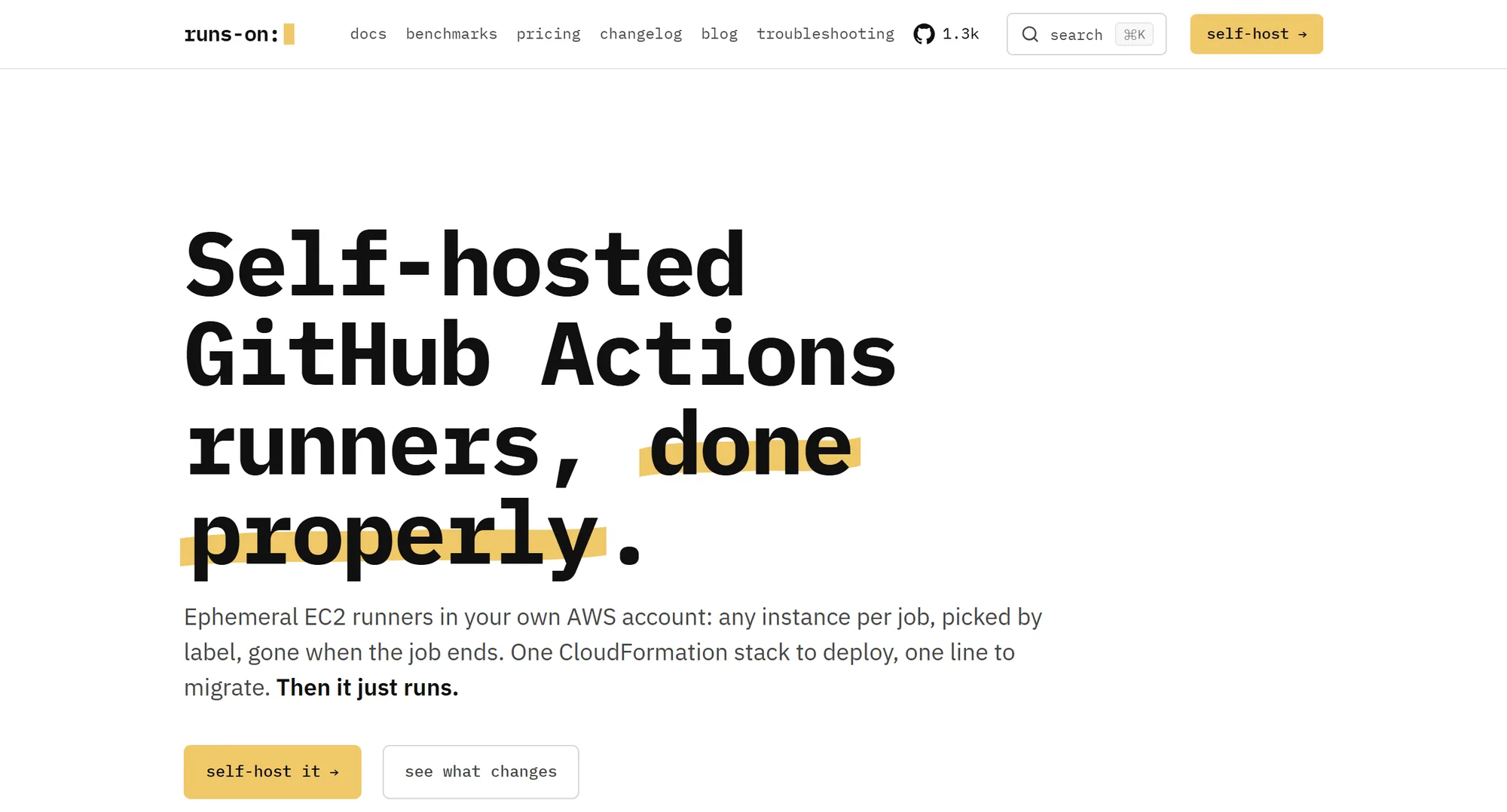
RunsOn launches one ephemeral EC2 instance per job in your own AWS account, from a single CloudFormation or Terraform stack. It runs Linux on x64 and arm64, Windows, and GPU instances; macOS jobs stay on GitHub-hosted runners. An S3 cache in your VPC and Docker layer caching are built in. As of September 2026, the license is a flat annual fee per legal entity, from about $348 (€300) a year on Starter to about $4,176 (€3,600) on Enterprise, and AWS bills the compute with no RunsOn markup. It is free for non-commercial use and has a 15-day trial.
Best for: runners inside your own AWS account for a flat license fee.
Consider if: you already run on AWS and want to pay for compute directly.
7. Cirun
Cirun offers "managed self-hosted runners at the fraction of cost, on your cloud." Runners start in your own account on AWS, Google Cloud, Azure, Oracle, OpenStack or DigitalOcean, set up in a .cirun.yml file, and can run Linux or Windows, on ARM or with GPUs such as the NVIDIA Tesla T4. As of September 2026, Cirun is free for public repositories, Startup is $29 per month for 3 private repositories and Business is $79 for 10, and the machines run on your own cloud bill.
Best for: GPU runners in your own cloud account, on the cloud of your choice.
Consider if: you maintain open source projects, which Cirun supports for free.
Managed vs self-hosted runners
8. GitHub-hosted runners
GitHub-hosted runners give each job a fresh virtual machine with nothing to operate, on Linux, Windows and macOS. Plans include 2,000 to 50,000 minutes a month, and standard runners are free in public repositories. As of September 2026, GitHub lists a standard 2-core Linux x64 runner at $0.006 per minute and rounds each job up to the whole minute.
Best for: zero setup, every operating system, and usage that fits your plan's minutes.
GitHub-hosted runner alternatives
9. Self-hosted runners with Actions Runner Controller
Actions Runner Controller (ARC) is "a Kubernetes operator that orchestrates and scales self-hosted runners for GitHub Actions." Runner scale sets grow and shrink with the number of workflows running, and runners can be ephemeral containers. GitHub does not charge per minute for self-hosted usage as of September 2026, but you are responsible for the operating system and software, and GitHub warns that self-hosted runners should almost never be used for public repositories.
Best for: jobs that must run in your network or on your hardware.
Consider if: you already run Kubernetes and have the time to harden and maintain it.
Managed vs self-hosted runners
Side by side
| Capability | CRACI | GitHub-hosted | Blacksmith | Depot | Namespace | WarpBuild | Self-hosted |
|---|---|---|---|---|---|---|---|
| Price, 2 vCPU Linux x64 | $0.004 per minute | $0.006 per minute | $0.004 per minute | $0.006 per minute beyond plan | $0.002 in plan, $0.003 overage | $0.004 per minute | No GitHub charge; you pay for hosts |
| Metering | Per second | Rounded up per job to the minute | Not stated | Per second | One-minute minimum, then per minute | Per minute | Your hosts, busy or idle |
| Free usage | No free tier | 2,000 to 50,000 minutes per month | 3,000 minutes per month | 7-day trial | Not stated | Free usage allowance | Not applicable |
| Windows and macOS | Linux only today | Windows in beta | Any host you run | ||||
| Docker layer caching | Not stated | Your setup | |||||
| Egress policy per job | Azure private networking | Static IPs | Block or advisory | BYOC network rules | You build it | ||
| SBOM of what each job fetched | With completeness state | Image scan with Syft | |||||
| Signed build provenance | No signed provenance | Artifact attestations | BuildKit image attestations | Tooling you add | |||
| Runs in your cloud or network | Customer-hosted runners, Enterprise | Azure private networking | Not stated | AWS, Business plan | Not stated | BYOC |
- Included
- Partly
- Not included
- On the roadmap
"Not stated" means we could not confirm it in the vendor's public pages.
When to stay with Namespace
- You want Linux, Windows and macOS runners from one vendor.
- You want to trial an egress policy in advisory mode before enforcing it.
- You depend on cache volumes or Bazel remote execution.
- You can mix: the choice is per job, so some jobs can move while the rest stay.
Read more about CI/CD integration, CRACI pricing and the GitHub Actions runners compared.
Namespace alternatives FAQ
Short answers to the questions teams ask when they compare
What is the best Namespace alternative?
It depends on what you need. For a lower price per minute, look at Ubicloud. For runners in your own cloud account, look at WarpBuild, RunsOn or Cirun. For Docker-heavy builds, Depot offers remote BuildKit builds. If you need a record of what each build fetched, CRACI records it on every job.
What is the cheapest Namespace alternative?
Ubicloud lists 2 vCPU at $0.00125 per minute on x64 and arm64, below Namespace's $0.002 in plan and $0.003 in overage, as of September 2026. Memory per vCPU and rounding differ, so compare those too: Namespace has a one-minute minimum per job, and CRACI meters per second.
Which Namespace alternatives run in my own cloud?
Namespace runs on hardware it operates. WarpBuild's bring-your-own-cloud option runs in AWS, GCP or Azure, Depot runs in your AWS account on the Business plan, RunsOn runs in your AWS account, and Cirun supports six clouds including OpenStack. CRACI runners are managed today, with customer-hosted runners on the roadmap for Enterprise.
Which alternatives support Windows, macOS or GPUs?
GitHub-hosted runners, Blacksmith, Depot and WarpBuild offer Windows and macOS, as Namespace does, with Windows in public beta on Blacksmith. RunsOn and Cirun offer Windows and GPU instances in your own cloud. CRACI runs Linux x86-64 and ARM64 today, with Windows and macOS on the roadmap.
What does Namespace do well?
Linux, Windows and macOS runners from one vendor, cache volumes on local storage, and Bazel remote execution. Its egress policies can run in advisory mode first, so you can build an allowlist from real traffic before you block.
Try a different runner on one job
Change runs-on on a single job, run it on CRACI, and compare the bill, the build and the SBOM.
Book a demo