Alternatives
NetRise alternatives
NetRise analyzes compiled firmware and binaries to build SBOMs and find risk, and it is now part of Dragos. If you want a different take on binary analysis, a PSIRT workflow, protection on the device, or a record from the software you build yourself, these are the options worth comparing.
Updated
We build CRACI, so weigh that in; we describe every option from its own documentation and say when another tool fits better.
Why teams look beyond NetRise
NetRise Turbine produces "a complete, binary-derived SBOM from the software itself" for firmware, container images and application binaries, including statically linked and embedded dependencies. It reports secrets, keys, certificates, misconfigurations and license issues that ship in the artifact, ranks vulnerabilities by whether an execution path reaches them, and imports and exports SPDX and CycloneDX. NetRise Provenance checks the origin and health of open-source components, and ZeroLens looks for weaknesses in compiled software. On September 21, 2026, Dragos announced that it had acquired NetRise and will integrate it into the Dragos Platform.
Teams still compare alternatives, usually for one of these reasons:
- The acquisition. Dragos is bringing NetRise into its platform for critical infrastructure operators. Device makers outside that market may want a vendor whose roadmap is aimed at them.
- Most of the software is their own. Analyzing a binary works backward from the output. A team that builds its own images can record what went into them instead.
- A PSIRT workflow. NetRise's site does not describe VEX, advisories or PSIRT investigations. Some teams want those in the same tool as the analysis.
- Pricing. NetRise publishes no prices.
What a PSIRT should look for
A PSIRT answers for every product the company ships. The tool behind it should help with:
- An inventory of what ships, including third-party firmware you never built.
- How the SBOM is produced, and whether the tool tells you when it is incomplete.
- Finding the affected products and releases quickly when a vulnerability lands.
- Monitoring after release, as new advisories appear for components already shipped.
- Triage, prioritization and VEX, so you can say which products are not affected.
- CI coverage, hosting options and how pricing scales.
The options
1. CRACI (our product)
CRACI is a GitHub Actions runner that produces the SBOM while the build runs. It is for teams that build their own
firmware and software. A package-aware proxy records what each job fetches from package and source hosts, including
packages restored from CI caches, and each SBOM states its completeness per job and per cache. Yocto builds run on
runners of up to 32 vCPUs and 96 GB of RAM: in a
side-by-side build of core-image-sato, CRACI's SBOM had every
component in Yocto's own SBOM plus 88 it missed, such as host packages and GitHub Actions, and a package URL for
each of the 653 Rust crate versions Yocto lists without one.
CRACI re-evaluates monitored SBOMs continuously, shows which builds contained a vulnerable dependency and which software versions are deployed to which products, supports VEX, and lets security teams triage findings and route each one to the team that owns the fix. You can add vendor SBOMs, so bought-in components are monitored next to your own builds. Because CRACI runs the job, it also enforces an egress policy that fails closed.
Best for: device makers and software teams that build on GitHub Actions and want the build, the SBOM and the vulnerability tracking in one place. Consider if: you can live without binary analysis, reachability and secrets findings in the output, none of which CRACI has; it cannot see inside firmware you did not build. It supports GitHub Actions only, with GitLab CI and Jenkins on the roadmap. See CRACI for PSIRT teams and CRACI vs NetRise.
2. ONEKEY
ONEKEY analyzes compiled firmware with "no source code or network access needed." It generates an SBOM from the binary, imports supplier SBOMs, exports CycloneDX and SPDX, looks for likely zero-days such as hardcoded credentials, and re-analyzes firmware daily. Its Compliance Wizard walks teams through the CRA, IEC 62443-4-2, ETSI EN 303 645 and the Radio Equipment Directive.
Best for: device makers checking firmware images they did not build, with guided checks against standards. Consider if: you want findings beyond known CVEs from a vendor focused on connected products. CRACI vs ONEKEY
3. Finite State

Finite State analyzes firmware, binaries, source code and supplier SBOMs, with "support for 50+ binary instruction set architectures," and brings them into one product record. It ranks findings by reachability, exploit intelligence and product context, records VEX decisions, and its compliance workflow covers CRA control mapping and audit-ready reports with SBOM and VEX artifacts. It embeds checks in GitHub Actions, GitLab CI and Jenkins.
Best for: connected-device makers who need analysis of firmware from many suppliers, with VEX decisions in the same place. Consider if: you want one platform across source, binaries and supplier SBOMs. CRACI vs Finite State
4. Cybellum
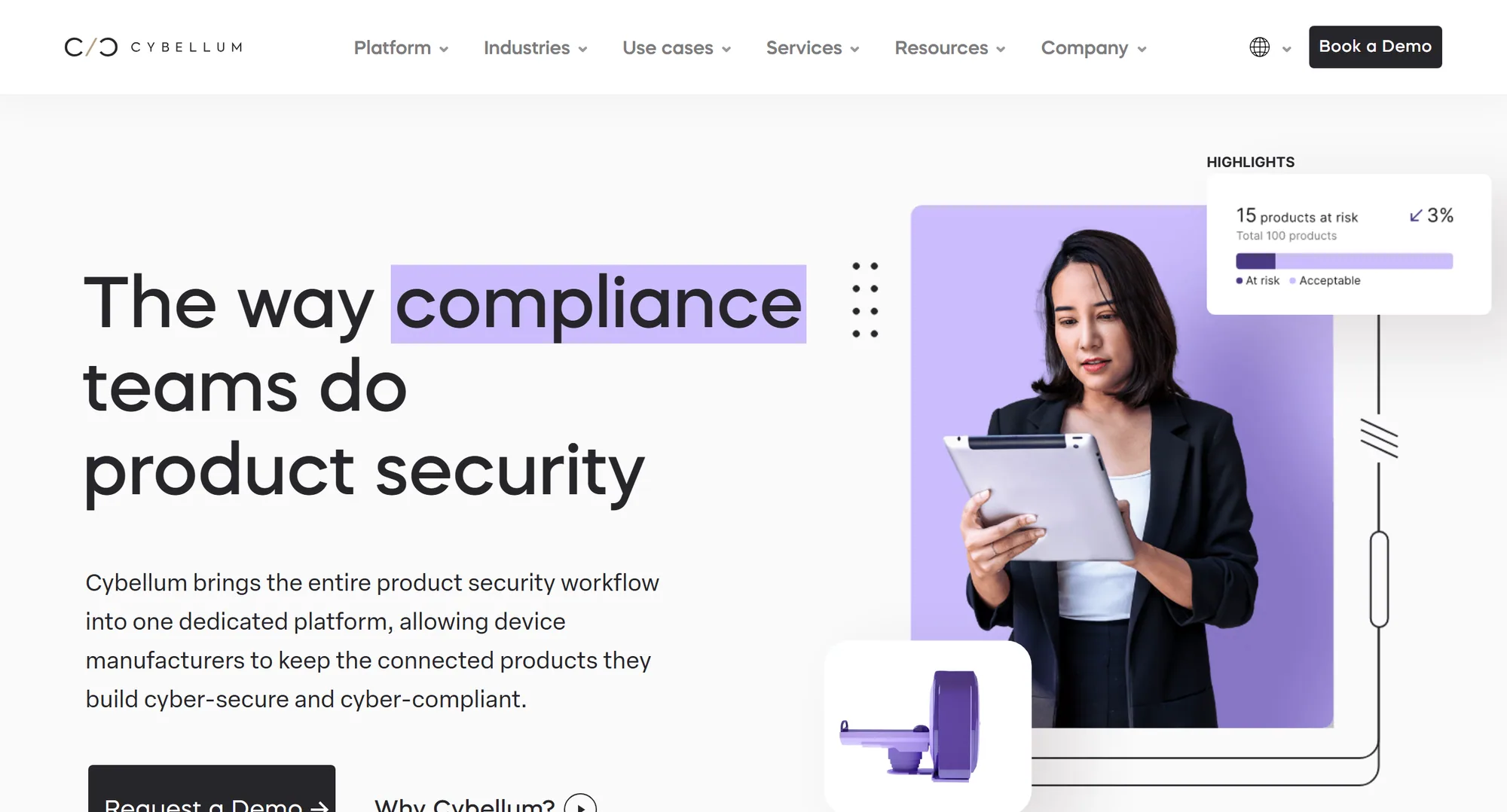
Cybellum's Product Security Platform creates SBOMs "by combining data from binary scanners, source code and external SBOM sources in SPDX, CycloneDX or CPEs CSV formats." Its vulnerability management triages and prioritizes findings, and it can create VEX reports. For PSIRT work it finds which products or components a new vulnerability affects, shares vulnerability status "via VEX/CSAF reports," and provides a workbench for creating and managing investigations. It also covers compliance with FDA requirements, ISO 21434 and the CRA.
Best for: automotive, medical and industrial manufacturers that want SBOMs, vulnerability management and PSIRT investigations in one platform. Consider if: the PSIRT workflow matters more to you than a standalone binary scanner. Cybellum publishes no prices.
5. ReversingLabs Spectra Assure
Spectra Assure analyzes compiled software packages without source code for malware, tampering, exposed secrets and
vulnerabilities, and produces CycloneDX and SPDX SBOMs from what it finds. Differential analysis compares versions
and flags suspicious changes between releases. The rl-secure CLI runs on premises and in CI.
Best for: a release gate for malware and tampering on the package you ship, or on commercial software before you deploy it. Consider if: device firmware is your main target rather than software packages. Community is free and Community+ is $500 per month (as of September 2026). CRACI vs ReversingLabs
6. Exein
Exein works on the device and on the firmware. Exein Runtime uses eBPF to monitor and block malicious behavior on
embedded Linux, and the open-source meta-exein Yocto layer puts its Pulsar agent into your image.
Exein Analyzer inspects firmware before release, or your SBOM when the binary is not available, ranks findings with
reachability scoring and LLM-powered filtering, and maps them to CRA requirements.
Best for: embedded Linux makers that want protection in the field as well as firmware analysis. Consider if: you are comfortable shipping an agent on the device. CRACI vs Exein
7. Cybeats
Cybeats SBOM Studio is a system of record that ingests, manages, monitors and shares SBOMs across products and suppliers. It scores SBOM quality at import and shares SBOMs and VEX with customers. For SBOM generation and binary composition analysis, Cybeats points to vendors in its Marketplace, and its RAVEN add-on reasons about reachability and drafts VEX.
Best for: medical, industrial and telecom manufacturers running an SBOM program across many products and suppliers. Consider if: you need the analysis itself; SBOM Studio manages SBOMs that another tool generated. CRACI vs Cybeats
Side by side
| Capability | CRACI | NetRise | ONEKEY | Finite State | Cybellum | ReversingLabs | Exein | Cybeats |
|---|---|---|---|---|---|---|---|---|
| SBOM produced during your build | Observed build traffic | |||||||
| Binary or firmware analysis | 50+ instruction sets | Merged with source and SBOMs | Software packages | Exein Analyzer | Through Marketplace vendors | |||
| Imports supplier SBOMs | Vendor SBOMs can be added | Not stated | When no binary is available | |||||
| Findings beyond known CVEs | Secrets, keys, misconfigurations | Zero-day analysis | Not stated | Not stated | Malware and tampering | Not stated | Not stated | |
| Reachability or exploitability ranking | Not stated | Not stated | Not stated | RAVEN add-on | ||||
| VEX | Not stated | Not stated | Not stated | Not stated | ||||
| Egress policy at the runner | ||||||||
| CI beyond GitHub Actions | GitLab CI and Jenkins | Not stated | Not stated | Not stated | Not stated | |||
| Published pricing | Pay per build minute, no monthly fee | Not stated | Not stated | Not stated | Not stated | Community free; Community+ $500/mo | Not stated | Not stated |
- Included
- Partly
- Not included
- On the roadmap
"NetRise" means NetRise Turbine, "Cybellum" means the Cybellum Product Security Platform, "ReversingLabs" means Spectra Assure, and "Cybeats" means SBOM Studio. ReversingLabs pricing is as of September 2026. "Not stated" means the capability is not described in the vendor's documentation, not that it is missing.
For the Cyber Resilience Act
NetRise, ONEKEY, Finite State, Cybellum and Exein all address the CRA. Its reporting obligations have applied since September 11, 2026, and its main provisions apply from December 11, 2027. A 24-hour early warning depends on knowing quickly which releases contain an affected component. For software you build, CRACI keeps the build history with each build's SBOM, so you can see which builds contained a vulnerable dependency. Its API returns SBOMs, network traces and provenance, SBOMs export as CycloneDX or SPDX, and CRACI submits the CRA notifications on your behalf.
No tool on this page makes a manufacturer compliant on its own. See what the CRA requires and PSIRT tools compared.
When to stay with NetRise
- You need SBOMs for firmware and binaries you buy as well as those you build, including statically linked code.
- You want secrets, keys, certificates and misconfigurations in the artifact reported next to CVEs.
- You rely on execution path reachability to cut the list of findings.
- You run operational technology and want firmware visibility inside the Dragos Platform.
For more, see Yocto builds on CRACI, ONEKEY alternatives and Finite State alternatives.
NetRise alternatives FAQ
Short answers to the questions teams ask when they compare
What is the best alternative to NetRise?
It depends on what you use NetRise for. For firmware analysis with findings beyond known CVEs and guided compliance checks, look at ONEKEY. For firmware, binaries, source code and supplier SBOMs in one product record with reachability, look at Finite State. For PSIRT investigations and VEX or CSAF reports on top of binary analysis, look at Cybellum. For malware and tampering checks on a release package, look at ReversingLabs Spectra Assure. For protection on the device, look at Exein. To manage SBOMs across many suppliers, look at Cybeats. If you build your own software in GitHub Actions, CRACI records the SBOM from each build and monitors it for vulnerabilities.
Is NetRise still sold after the Dragos acquisition?
Dragos announced the acquisition of NetRise and runZero on September 21, 2026, without financial terms. Dragos says NetRise leadership will integrate it into the Dragos Platform while continuing to serve existing customers, and netrise.io still presented Turbine, Provenance and ZeroLens in October 2026. Ask NetRise or Dragos how it will be sold from here.
Can CRACI analyze firmware like NetRise?
No. CRACI does not analyze binaries or firmware images, does not do reachability analysis, and does not look for secrets or misconfigurations in the output. It records what your own builds fetch while they run on CRACI's GitHub Actions runners, including Yocto builds, and produces the SBOM from that record. For firmware you receive as a binary, you can add the vendor's SBOM to CRACI so its components are monitored, but without an SBOM you need a binary analysis tool.
Which of these tools help a PSIRT find affected products?
Cybellum describes a PSIRT workbench that finds which products or components a new vulnerability affects. Finite State and Cybeats keep a record across products and suppliers. CRACI shows which builds contained a vulnerable dependency, direct or transitive, and its inventory view shows which software versions are deployed to which products. Binary analysis tools such as NetRise and ONEKEY tell you what is inside firmware you did not build.
Is a build-time SBOM better than one from binary analysis?
For software you build, a build-time SBOM records what went in instead of inferring it from the output, which is hard for compiled code such as Rust and C. Binary analysis is still the only option for firmware you did not build. In a side-by-side core-image-sato build, CRACI's SBOM had every component in Yocto's own SBOM plus 88 it missed, and a package URL for each of the 653 Rust crate versions Yocto lists without one.
Record your firmware build
Book a demo and we will run one of your GitHub Actions builds on CRACI and walk through what it fetched.
Book a demo