Comparison
Vulnerability management tools compared
Vulnerability management tools find known vulnerabilities, rank them and track them to a fix. The name covers two different jobs: scanning the servers, endpoints and cloud accounts you run, and tracking the open-source components inside the software you build. Here are the leading tools for each, the free options, and where CRACI fits.
Updated
Who this is for
This page is for teams choosing a vulnerability management tool, or checking whether the one they have covers what they ship. We build CRACI, so weigh that in. Every claim about another product comes from that vendor's own site or documentation, checked in September 2026.
Two kinds of vulnerability management
| Infrastructure vulnerability management | Software vulnerability management | |
|---|---|---|
| Protects | What you run: servers, laptops, network devices, cloud accounts | What you build and ship: applications, images, firmware |
| Finds vulnerabilities in | Operating systems, installed software, configurations | Open-source and third-party components, direct and transitive |
| Fix | Patch the system | Upgrade the dependency, rebuild and release |
| Typical buyer | IT and security operations | Product security and engineering |
| Examples | Tenable, Qualys, Rapid7, Microsoft Defender | Snyk, Endor Labs, GitHub, Dependency-Track, CRACI |
The two overlap at the edges. Qualys now reads open-source components through its agent at runtime, and several platforms scan container images. But a host scanner sees what is installed on a machine, not which release of your product shipped which dependency. If you sell software, you need an answer to both questions.
How to choose
- What do you need to cover? Infrastructure, the software you build, or both. Pick a tool per job rather than stretching one across both.
- How does it rank findings? Look for exploitation signals, not only CVSS: CISA KEV, EPSS, threat intelligence, and for code, reachability. See vulnerability prioritization for the method.
- Where does its inventory come from? Agents and network scans for hosts; manifests, source code, images or a record of the build for software. The ranking can only be as good as the list it ranks.
- What happens after a finding? Patching, fix pull requests, ticketing, routing to owners, and verification that the fix actually shipped.
- What do you have to prove? Customers, auditors and the EU Cyber Resilience Act increasingly ask for an SBOM per release and a record of how vulnerabilities were handled.
- How do you want to pay? Per asset, per developer, per committer, per plan or by quote.
At a glance
The two kinds of tools answer different questions, so they get separate tables. "Not stated" means the vendor pages we cite do not say either way. Pricing is as of September 2026.
Infrastructure and endpoint vulnerability management
| Capability | Tenable | Qualys VMDR | Rapid7 | Microsoft Defender VM |
|---|---|---|---|---|
| Covers | Networks, cloud, containers, web apps, OT | Hosts, endpoints, cloud, containers | On premises, cloud, containers, apps, IaC | Endpoints and network devices |
| How it finds assets | Nessus scanners; agentless for cloud | Cloud Agent, scanners, cloud connectors | Agents | Defender for Endpoint sensor, agentless scanners |
| Risk score | VPR | TruRisk and QDS | Active Risk (0 to 1,000) | Risk-based prioritization |
| Uses EPSS | In QDS | Not stated | Not stated | |
| Uses CISA KEV | In VPR | Not stated | ||
| Patching | Tenable Patch Management | Patch Management | Not stated | Remediation tasks in Intune |
| Dependencies of software you build | Not stated | Runtime SCA through the agent | Not stated | Not stated |
| Pricing | From $3,700 per year for 100 assets | Quote | Quote | Included in Defender for Endpoint P2; add-on or standalone |
- Included
- Partly
Vulnerability management for the software you build
| Capability | CRACI | Snyk | Endor Labs | GitHub (GHAS) | Dependency-Track | Grype |
|---|---|---|---|---|---|---|
| Where the component list comes from | Records the build | Manifests and lockfiles | Analyzes source code | Manifests plus submitted data | SBOMs you upload | Images, filesystems and SBOMs |
| Continuous monitoring | Dependabot alerts | You run it | ||||
| Reachability prioritization | Function level | Not stated | Not stated | Not stated | ||
| Signed artifact provenance | No signed provenance | Not stated | endorctl | Artifact attestations | Not stated | Not stated |
| SBOM export | Completeness stated | Enterprise plans only | SPDX | Ingests CycloneDX | Via Syft | |
| CI beyond GitHub Actions | GitLab CI and Jenkins | Not stated | ||||
| Pricing | $0.002 per vCPU-minute ($0.004 for 2 vCPU), metered per second; no monthly fee | Free tier; Team from $25 per month | Free Developer tier; paid tiers via sales | $19 and $30 per committer per month | Free, Apache 2.0 | Free, Apache 2.0 |
- Included
- Partly
- Not included
- On the roadmap
Infrastructure vulnerability management tools
Tenable Vulnerability Management
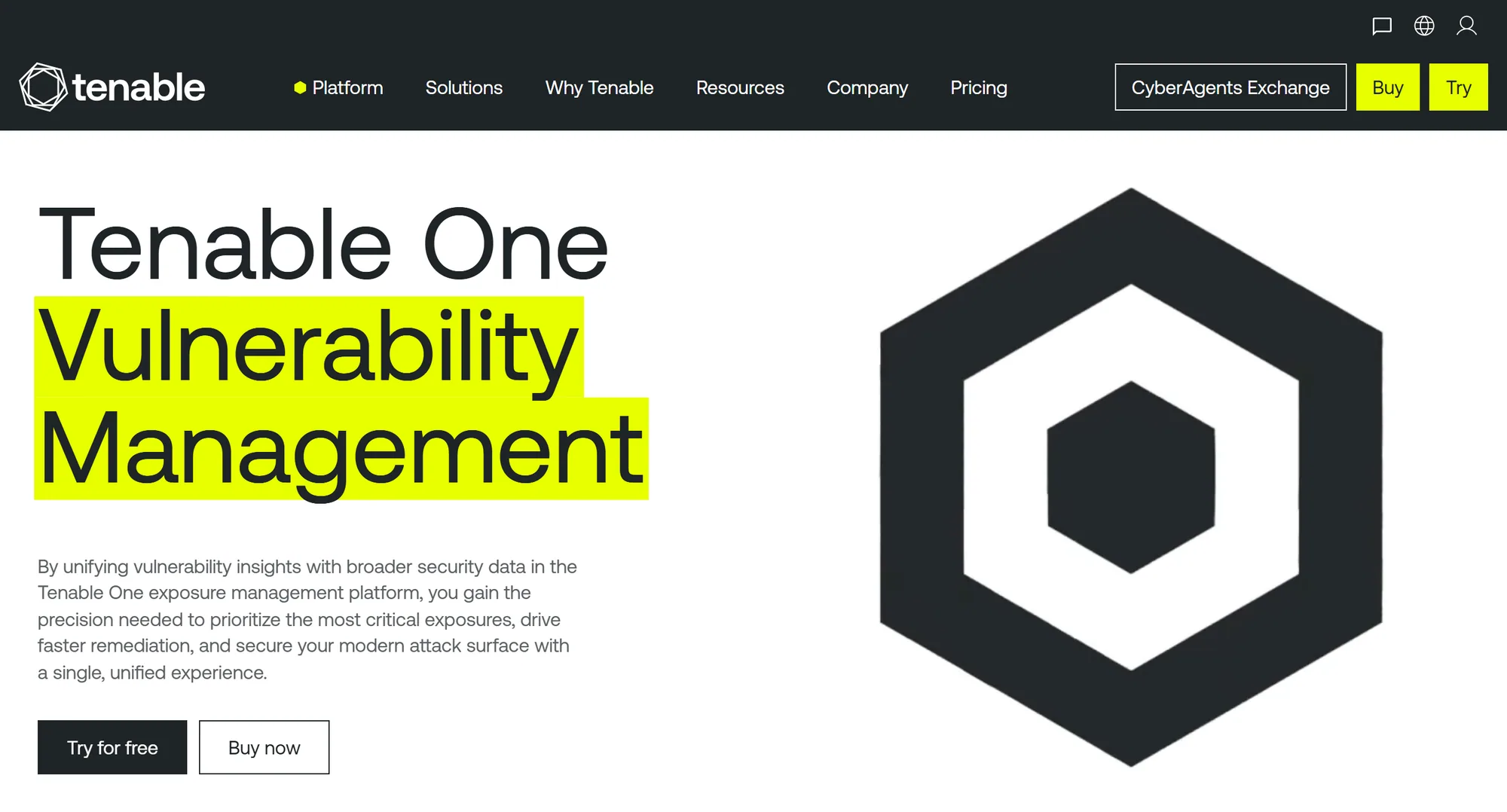
Tenable now sells Vulnerability Management as part of Tenable One, its exposure management platform. It covers networks, cloud workloads (agentless), containers, web applications and OT, with Nessus as the scanner underneath. Its Vulnerability Priority Rating (VPR) takes CISA KEV status into account, and findings show EPSS next to CVSS. Tenable Patch Management and two-way ticketing handle remediation. Best for organizations that want the widest asset coverage from one vendor. Pricing is public: from $3,700 per year for 100 assets, with Nessus Professional at $4,790 per year.
Qualys VMDR
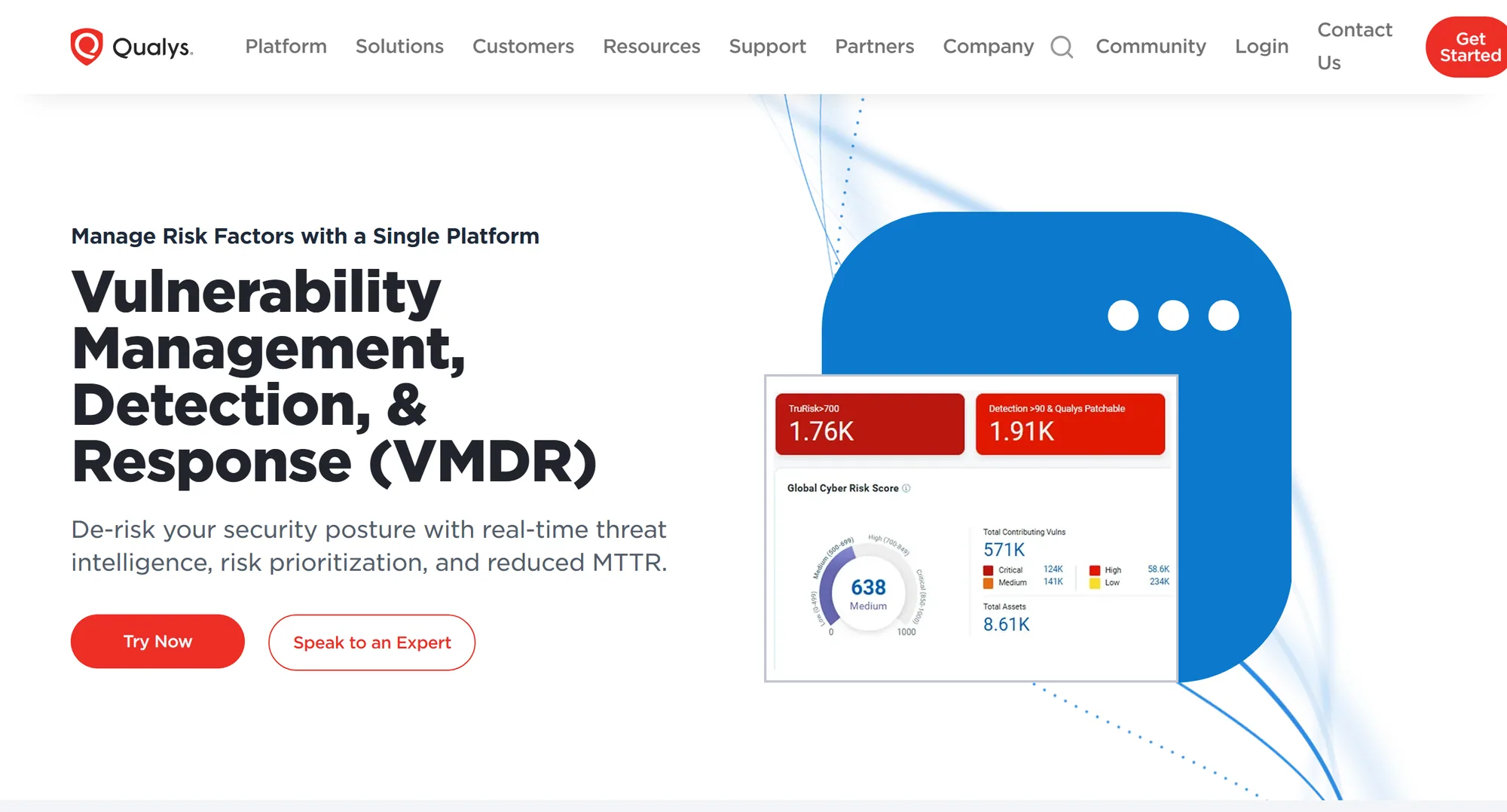
Qualys VMDR (Vulnerability Management, Detection and Response) collects data through its Cloud Agent, network scanners and API-based cloud connectors. TruRisk scores risk from CVSS, CISA KEV, exploit code maturity, malware, ransomware and threat actor data, and the Qualys Detection Score uses EPSS and KEV due dates as inputs. Patch Management and ServiceNow ticketing close the loop, and its Software Composition Analysis finds vulnerable open-source components at runtime through the agent. Best for agent-based coverage with built-in patching. Pricing is by quote.
Rapid7 Exposure Command (InsightVM)
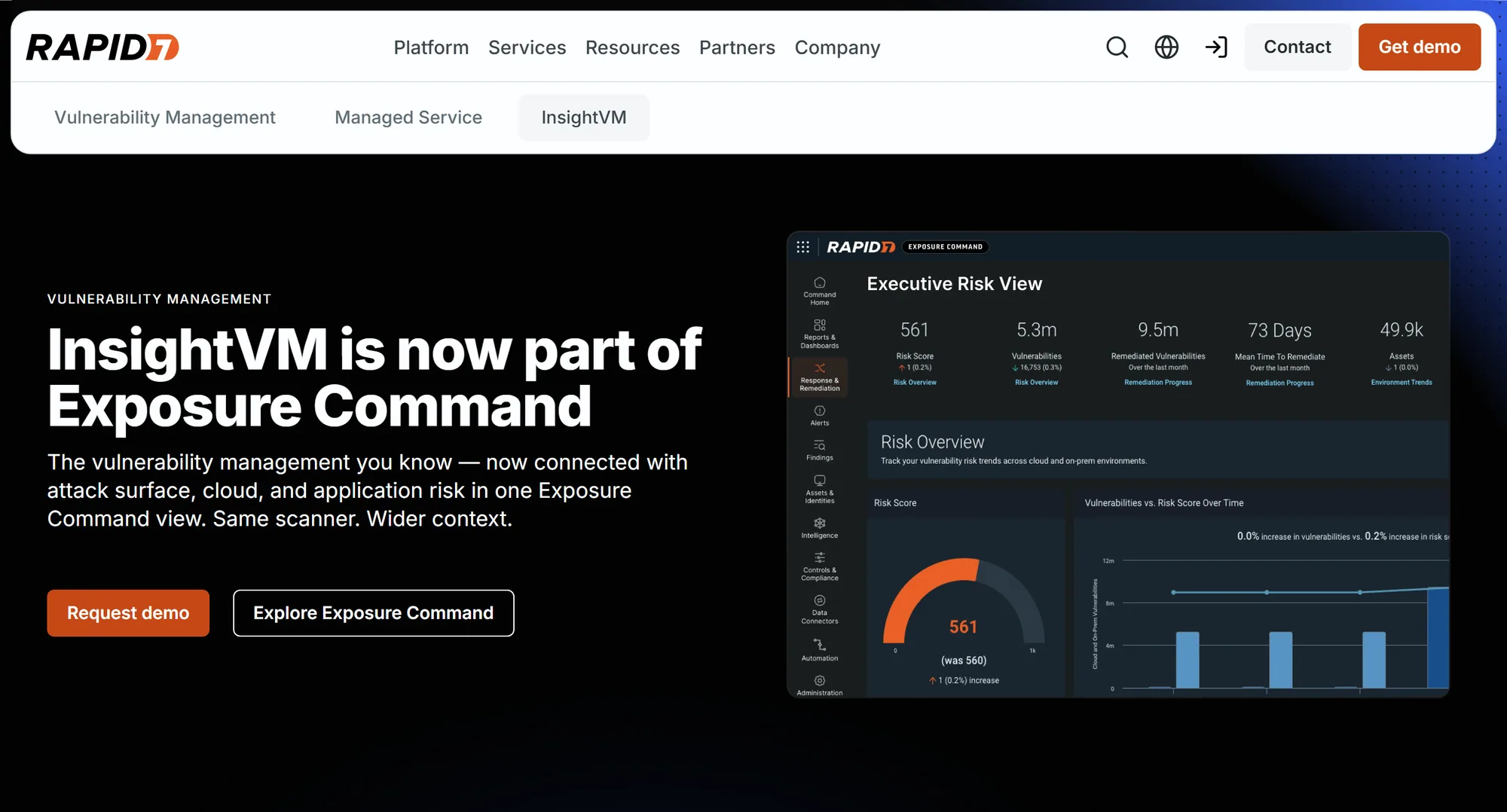
InsightVM is now part of Rapid7 Exposure Command, sold as Essentials (vulnerability management and attack surface) or Ultimate (adding cloud and application security). It covers on-premises and cloud assets, containers, applications and infrastructure as code. Its Active Risk score, from 0 to 1,000, combines CVSS with threat feeds including AttackerKB, Metasploit, ExploitDB and the CISA KEV list. Remediation workflows and more than 500 integrations handle ticketing. Best for teams that want vulnerability management and attack surface monitoring together. Pricing is by quote.
Microsoft Defender Vulnerability Management
Defender Vulnerability Management covers endpoints on Windows, macOS, Linux, Android and iOS, and network devices, with inventories of software, certificates, hardware, firmware and browser extensions. Prioritization combines Microsoft threat intelligence, breach likelihood and business context, and remediation runs through Intune tasks. Core capabilities come with Defender for Endpoint Plan 2, with a premium add-on and a standalone version for other EDR products. Best for organizations already on Microsoft Defender. It does not cover the software you build.
Wiz
Wiz scans VMs, containers and serverless functions without agents, and pulls in findings from third-party scanners for on-premises assets. It ranks vulnerabilities with context from its Security Graph: network exposure, identities, data sensitivity and attack paths. It also generates SBOMs of cloud workloads in SPDX and CycloneDX. Best for cloud-first organizations. Pricing is by quote. CRACI vs Wiz
Vulnerability management for the software you build
Snyk
Snyk is a developer-first platform that runs in the IDE, the CLI, SCM integrations and CI. It prioritizes dependency
findings with reachability, exploit maturity, EPSS and CVSS, and opens upgrade pull requests. Its dependency tree
comes from manifests and lockfiles, and snyk sbom is available only on Enterprise plans.
CRACI vs Snyk
Endor Labs
Endor Labs is built around function-level reachability, tracing code paths from your source to the vulnerable function in direct and transitive dependencies. It adds upgrade impact analysis, backported patches and a Package Firewall. Best for teams drowning in dependency alerts. CRACI vs Endor Labs
GitHub Advanced Security and Dependabot
Every GitHub plan includes the dependency graph and Dependabot alerts. Code Security adds dependency review and CodeQL, and artifact attestations add signed provenance. The dependency graph describes the repository's manifests and lock files, plus any data submitted to it. CRACI vs GitHub Advanced Security
Free and open-source vulnerability management tools
- OWASP Dependency-Track ingests CycloneDX SBOMs and analyzes them continuously against the NVD, GitHub Advisories, OSV and other sources, with a policy engine and EPSS for prioritization. Apache 2.0. CRACI vs Dependency-Track
- Grype scans images, filesystems and SBOMs and reports EPSS and KEV data with its findings. Trivy scans images, repositories, VM images and Kubernetes. Both Apache 2.0. CRACI vs Syft and Grype
- DefectDojo aggregates findings from other scanners, deduplicates them and tracks remediation. BSD 3-Clause, an OWASP Flagship project, with a paid Pro edition.
- OpenVAS, the scanner in Greenbone Community Edition, scans networks against a continuously updated feed of vulnerability tests.
- Nessus Essentials is not open source, but it is free: a 30-day license for non-commercial use on up to 5 IP addresses.
Free tools leave the program around them to you: monitoring, triage, assignment and reporting.
How CRACI fits
CRACI is vulnerability management for the software you build on GitHub Actions. Every other software tool above works out what is in your product from files: manifests, lockfiles, source code, images or an uploaded SBOM. CRACI runs your GitHub Actions jobs and records the packages each job actually fetched, including transitive dependencies, packages restored from caches and hidden dependencies no lockfile lists. CRACI has found vulnerable packages that Snyk and Aikido did not report, because their scans were missing the components.
- Monitored SBOMs are re-evaluated continuously, and organization views aggregate findings across repositories.
- Build history shows which past builds contained a vulnerable dependency, so you know the exposure period.
- Security teams triage findings and route each one to the team that owns the fix, and CRACI supports VEX.
- Policy gates can block a build on findings, including a build that contains a specific CVE.
- For actively exploited vulnerabilities under the CRA, CRACI submits the notifications to the authorities on the manufacturer's behalf.
CRACI is not the right choice when:
- you need to scan servers, endpoints or cloud accounts (pick one of the infrastructure tools above),
- reachability is your priority (CRACI does not offer it),
- your pipelines run on GitLab, Jenkins or CircleCI, or need Windows or macOS runners (CRACI runs Linux jobs on GitHub Actions today; other CI systems, Windows and macOS are on the roadmap).
See vulnerability tracking, compare SCA tools, or book a demo to see the record of a GitHub Actions build.
CRACI compared with each tool
- CRACI vs Snyk What your manifests declare vs what your build did.
- CRACI vs Aikido A broad AppSec suite vs deterministic build evidence.
- CRACI vs Sonatype Repository gatekeeping and SCA vs build evidence.
- CRACI vs Black Duck Code, snippet and binary scanning vs build evidence.
- CRACI vs Mend.io Dependency scanning vs dependency observation.
- CRACI vs Checkmarx AppSec testing platform vs build-time evidence.
- CRACI vs Endor Labs Reachability analysis vs build observation.
- CRACI vs JFrog Artifact management vs per-build evidence.
- CRACI vs GitHub Advanced Security Code, secret and dependency scanning vs build evidence.
- CRACI vs Dependabot Version updates vs knowing what your builds used.
Side by side
Several tools on one page, for when you are choosing a category, not one product.
Vulnerability management tools FAQ
Short answers to common questions about vulnerability management tools
What is a vulnerability management tool?
A tool that finds known vulnerabilities in your assets, ranks them by risk and tracks them until they are fixed or accepted. Infrastructure platforms such as Tenable, Qualys and Rapid7 cover hosts, endpoints and cloud. Software-focused tools such as Snyk, Endor Labs and Dependency-Track cover the open-source components in the software you build.
What is the best vulnerability management tool?
It depends on what you need to cover. For servers, laptops and cloud accounts, look at Tenable, Qualys, Rapid7 or Microsoft Defender Vulnerability Management. For the dependencies in software you build and ship, look at SCA tools and SBOM-based tools. Most organizations that ship software need one of each.
Are there free vulnerability management tools?
Yes. OpenVAS (Greenbone Community Edition) scans networks, DefectDojo aggregates findings from other scanners, Dependency-Track monitors SBOMs, and Grype and Trivy scan images and file systems. Nessus Essentials is a free 30-day license for non-commercial use on up to 5 IP addresses.
What is the difference between vulnerability management and vulnerability scanning?
Scanning finds vulnerabilities at a point in time. Vulnerability management is the continuous program around it: inventory, scanning, prioritization, assignment, remediation, verification and reporting. Most tools on this page do both.
Which vulnerability management tools use EPSS and CISA KEV?
Tenable uses both (KEV feeds its VPR score, and EPSS is shown with findings). Qualys uses both in its Qualys Detection Score. Rapid7's Active Risk uses the KEV list. Among open-source tools, Grype reports EPSS and KEV data and Dependency-Track uses EPSS.
Is CRACI a vulnerability management tool?
For software you build on GitHub Actions, yes. CRACI records the packages each build actually fetched, monitors the resulting SBOMs for new vulnerabilities, shows which builds contained a vulnerable dependency, and lets security teams triage and route findings. It does not scan hosts, endpoints or cloud accounts.
See which of your builds ship a vulnerable package
Book a demo and run one of your GitHub Actions workflows on CRACI. Get a record of every package the build pulled in, monitored for new vulnerabilities.
Book a demo