Alternatives
Checkmarx alternatives
The main Checkmarx alternatives are Snyk for developer-facing scanning, Veracode, Black Duck and Mend.io for a broad AppSec portfolio, Endor Labs and Semgrep for reachability, Aikido for small teams, GitHub Advanced Security for GitHub-native teams, and CRACI when you need a record of what each build shipped.
Updated
We build CRACI, so weigh that in; we describe every option from its own documentation and say when another tool fits better.
The best Checkmarx alternatives at a glance
| Capability | Best for | Pricing (September 2026) |
|---|---|---|
| CRACI | A record of what each GitHub Actions build fetched and shipped | Pay per build minute, no monthly fee |
| Snyk | Developer-facing scanning from the IDE to the pull request | Free tier; Team from $25 per month |
| Veracode | A like-for-like AppSec portfolio, with pen testing on top | Not stated |
| Black Duck | Snippet and binary scanning next to SAST | Quote |
| Mend.io | SAST and reachable SCA in one contract, with Renovate | Up to $1,000 per contributing developer per year |
| Endor Labs | Cutting dependency alert volume with reachability | Free Developer tier; paid tiers via sales |
| Semgrep | Customizable SAST plus reachable SCA | Free up to 10 contributors; Teams from $30 per contributor per month |
| Aikido | Small teams that want one tool for most scanning | Free plan; paid from $350 per month |
| GitHub Advanced Security | Teams that want to stay inside GitHub | $19 and $30 per active committer per month |
Why teams look beyond Checkmarx
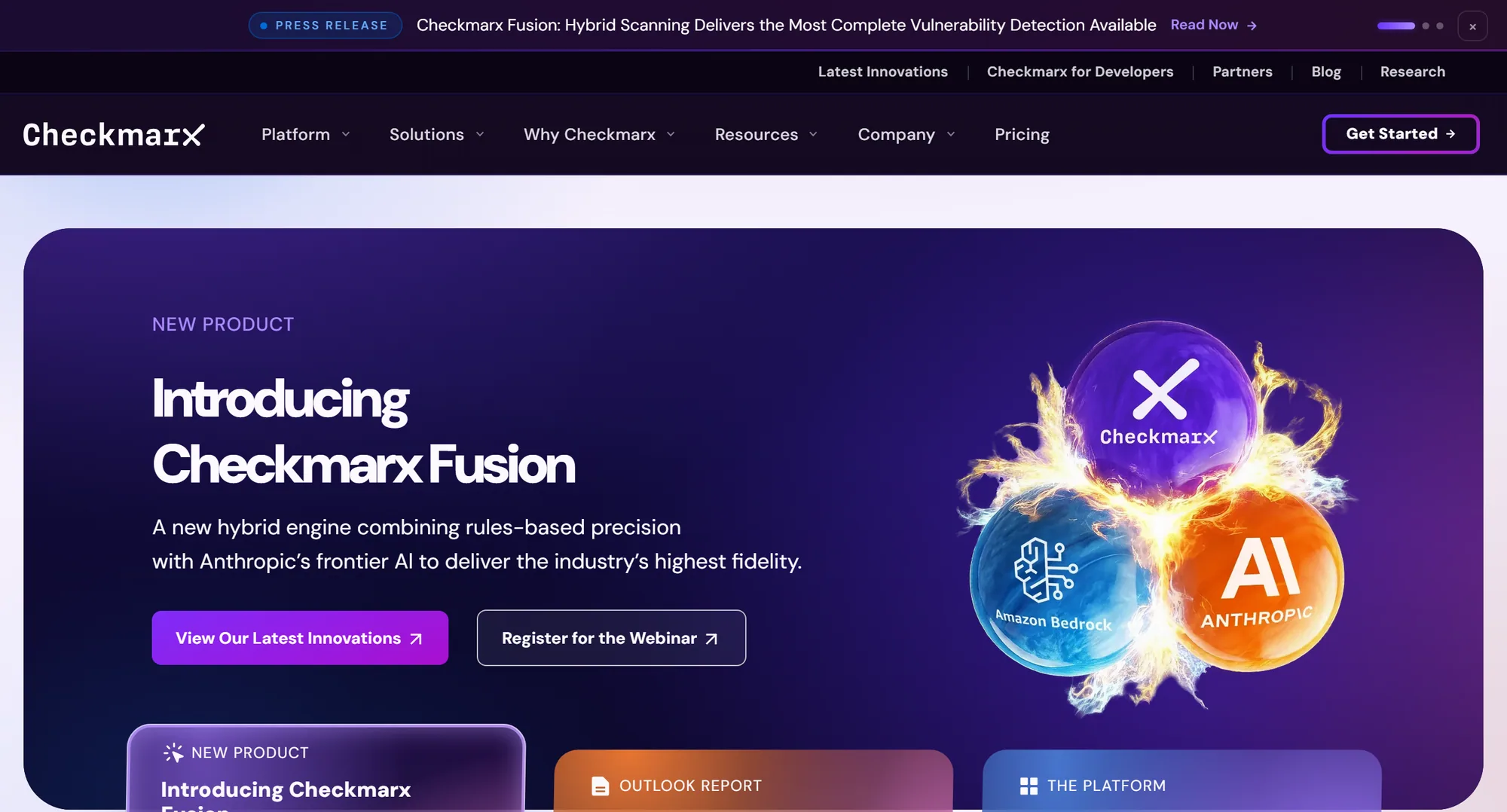
Checkmarx One is a broad application security platform. It covers SAST, SCA, secrets detection, IaC, API security, container security and DAST, adds malicious package protection and repository health, and brings the findings together in its ASPM layer. Its SCA uses exploitable path analysis to find which vulnerable functions your code may call, and policies can alert, prevent pull requests and break builds. It plugs into Jenkins, TeamCity, Azure DevOps, GitHub Actions, GitLab and more.
Teams still compare alternatives, usually for reasons of scope and fit rather than quality:
- You need less than the full platform. Checkmarx prices by quote, based on the modules you need, the deployment model and the developers in scope (as of September 2026). If your need is mostly dependencies or SAST, a narrower tool may fit better.
- You want developer-first tooling. Some teams choose tools built around the IDE and the pull request, with published per-developer prices.
- You want fewer findings to triage. Several alternatives compete on reachability, which checks whether your code can call the vulnerable function before a finding reaches a developer.
- You need evidence of what went into each release. The Checkmarx One GitHub Action uploads a zip archive of your source for scanning, and SCA Resolver resolves dependencies on premises. Either way, the analysis starts from the project, not from what the build actually fetched.
- You are consolidating on GitHub. Some teams want their security tools where their code and workflows already live.
What to look for
- Which Checkmarx modules you actually use: SAST, SCA, secrets, IaC, API security, DAST or containers.
- How dependency findings are prioritized: reachability, exploit data, or both.
- Where the dependency list comes from: manifests, source analysis, binaries, or the build itself.
- SBOM export: formats, which plan includes it, and whether it tells you when the record is incomplete.
- Which CI systems and source control platforms you need supported today.
- The pricing unit: per developer, per contributor, per committer, per module or per usage.
The options
1. CRACI (our product)
CRACI is the runner your GitHub Actions jobs execute on. It replaces the runner, not GitHub Actions, so runs still appear in GitHub. While each job runs, a package-aware proxy records every external dependency it fetches from npm, PyPI, RubyGems, Cargo, Go, Nix, OCI, apt, apk and Git sources, including packages restored from CI caches and hidden dependencies that no lockfile lists, such as code downloaded by install hooks. Each SBOM (CycloneDX or SPDX) states its completeness per job and per cache. CRACI has found vulnerable packages that Snyk and Aikido did not report, because their scans were missing the components.
CRACI re-evaluates monitored SBOMs continuously, supports VEX, and lets policy gates block a build on findings, including a specific CVE, or on a license. It enforces an egress policy that fails closed. CRACI's inventory view shows exactly which software versions are deployed to which products, globally.
Best for: teams on GitHub Actions that want the dependency and SBOM side of Checkmarx to come from the build itself, with the runner and its controls in the same product. What you give up: CRACI does no SAST, secrets, IaC, API or DAST scanning, by design, and no reachability analysis. It flags known malicious releases once a CVE is published but does not detect new malicious packages. It supports GitHub Actions on Linux only today, with GitLab CI and Jenkins on the roadmap. If you rely on those Checkmarx modules, keep a code scanner for them. CRACI vs Checkmarx One
2. Snyk
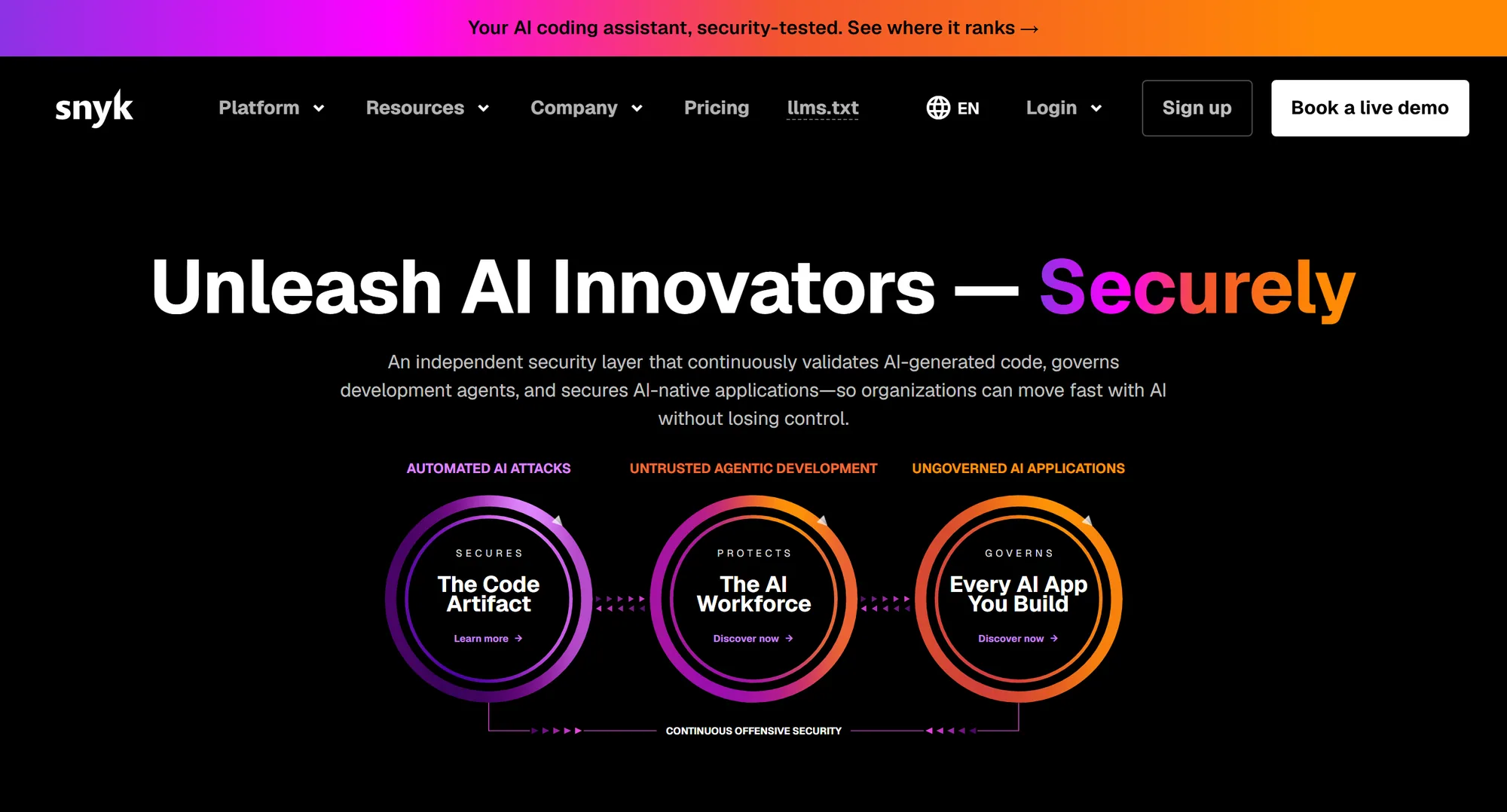
Snyk is a developer security platform that runs in the IDE, the CLI, against repositories and in CI. Snyk Open Source prioritizes dependency findings with reachability, exploit maturity, EPSS and CVSS, opens upgrade pull requests and supports license policies. Snyk Code, Snyk Container and Snyk Infrastructure as Code cover first-party code, images and IaC.
Best for: teams that want security feedback where developers work. Consider if:
you want published prices: Team from $25 per month and
Enterprise by quote (as of September 2026). The snyk sbom command is Enterprise only.
CRACI vs Snyk
3. Veracode
Veracode is an application security platform with SAST, DAST, container security, penetration testing as a service, Veracode Fix for AI remediation, and Risk Manager for application security posture. Veracode SCA prioritizes by exploit paths and dependency relationships, generates CycloneDX and SPDX SBOMs, opens automatic pull requests and applies custom policy. It also detects and blocks malicious packages.
Best for: teams that want SAST, DAST and SCA from one vendor, with pen testing on top. Consider if: you want the closest like-for-like swap for a Checkmarx One portfolio. Veracode's product pages we cite publish no prices.
4. Black Duck
Black Duck SCA combines package manager scanning with signature scanning, snippet detection and binary analysis, so it finds open source that nobody declared. Its KnowledgeBase tracks more than 2,750 licenses. Coverity adds SAST across 22 languages, and Black Duck Binary Analysis inspects executables and firmware without source code.
Best for: codebases with copied or vendored open source, and deep license work. Consider if: snippet or binary scanning matters to you. Pricing is by quote, with no published prices (as of September 2026). CRACI vs Black Duck
5. Mend.io
Mend AppSec combines Mend SAST (30+ languages) with Mend SCA, which traces the call graph through transitive dependencies for reachability, enforces license policies and flags malicious packages. The Mend CLI also scans containers and IaC, and Mend Renovate keeps dependencies current across 90+ package managers.
Best for: teams that want SAST, reachable SCA and automated updates in one contract. Consider if: you already use Renovate. Mend AppSec is priced at up to $1,000 per contributing developer per year (as of September 2026). CRACI vs Mend.io
6. Endor Labs
Endor Labs is built around function-level reachability through static program analysis of direct and transitive dependencies, which it says cuts SCA findings by 92%. It adds upgrade impact analysis, automated upgrade pull requests, Endor Patches that backport fixes, AI SAST, secrets and container scanning, a Package Firewall, and an SBOM Hub with VEX.
Best for: teams whose main problem is the volume of dependency alerts. Consider if: you are fine with sales-led pricing; beyond the free Developer tier, Core and Pro are sold per contributing developer (as of September 2026). CRACI vs Endor Labs
7. Semgrep
Semgrep has three products: Semgrep Code for SAST, Semgrep Supply Chain for SCA, and Semgrep Secrets. Supply Chain classifies findings as reachable, conditionally reachable or unreachable, and Semgrep says this reduces false positives by up to 98%. It also checks licenses, detects malicious dependencies, opens upgrade pull requests and exports CycloneDX SBOMs. It runs in GitHub Actions, GitLab CI/CD, Jenkins, Bitbucket, CircleCI, Buildkite, Azure Pipelines and Semaphore.
Best for: teams that want to write their own SAST rules and pair them with reachable SCA. Consider if: you want to buy products one at a time. The free plan covers up to 10 contributors and 10 repositories; Teams starts at $30 per contributor per month for Code or Supply Chain and $15 for Secrets (as of September 2026).
8. Aikido
Aikido is a broad AppSec suite. Every plan lists SCA, SAST, secrets, IaC, cloud posture, container scanning, DAST, license scanning and SBOM generation. Its SCA uses function-level reachability, AutoFix opens pull requests, and it can block pull requests with critical findings.
Best for: smaller teams that want one tool and one dashboard for most scanning needs. Consider if: you want Checkmarx's breadth at a smaller scale. There is a free Developer plan, and paid plans start at $350 per month (as of September 2026). CRACI vs Aikido
9. GitHub Advanced Security
Two paid products on top of GitHub's platform features. Secret Protection covers secret scanning and push protection. Code Security covers CodeQL code scanning, Copilot Autofix and dependency review. They build on the dependency graph and Dependabot alerts and security updates, which all GitHub plans include, and the graph exports as an SPDX SBOM.
Best for: teams whose code and workflows already live on GitHub and want fewer vendors. Consider if: CodeQL plus Dependabot covers your needs. Secret Protection is $19 and Code Security $30 per active committer per month, on Team or Enterprise (as of September 2026). CRACI vs GitHub Advanced Security
Side by side
Ten products do not fit one table, so they are split in two, with CRACI and Checkmarx One in both. "Not stated" means the vendor pages we cite do not say either way; Veracode is described from its SCA product page and documentation. Prices are as of September 2026. For CRACI's current terms, see pricing.
AppSec portfolios
| Capability | CRACI | Checkmarx One | Snyk | Veracode | Black Duck | Mend.io |
|---|---|---|---|---|---|---|
| Runs your CI jobs | Jobs run on CRACI runners | |||||
| Dependencies recorded from the build | Uploaded source archive | |||||
| Egress policy for build jobs | ||||||
| SBOM export | Per build | Enterprise plans | CycloneDX, SPDX | |||
| Continuous monitoring | Not stated | Not stated | Not stated | |||
| Reachability prioritization | Exploit paths | |||||
| SAST for your own code | Coverity | |||||
| IaC scanning | Not stated | Not stated | ||||
| CI beyond GitHub Actions | GitLab CI and Jenkins | Not stated | ||||
| Pricing | Pay per build minute, no monthly fee | Quote | Free tier; Team from $25/mo | Not stated | Quote | Up to $1,000 per contributing developer/yr |
- Included
- Partly
- Not included
- On the roadmap
Reachability, all-in-one and GitHub-native tools
| Capability | CRACI | Checkmarx One | Endor Labs | Semgrep | Aikido | GitHub Advanced Security |
|---|---|---|---|---|---|---|
| Runs your CI jobs | Jobs run on CRACI runners | |||||
| Dependencies recorded from the build | Uploaded source archive | Submitted build data | ||||
| Egress policy for build jobs | Not stated | |||||
| SBOM export | Per build | CycloneDX | SPDX | |||
| Continuous monitoring | Not stated | Not stated | Not stated | |||
| Reachability prioritization | Not stated | |||||
| SAST for your own code | Semgrep Code | CodeQL | ||||
| IaC scanning | Not stated | Not stated | Not stated | |||
| CI beyond GitHub Actions | GitLab CI and Jenkins | Not stated | ||||
| Pricing | Pay per build minute, no monthly fee | Quote | Free tier; paid via sales | Free up to 10 contributors; Teams from $30 per contributor/mo | Free tier; paid from $350/mo | $19 and $30 per committer/mo |
- Included
- Partly
- Not included
- On the roadmap
When to stay with Checkmarx
- You want one vendor for SAST, SCA, secrets, IaC, API security, containers and DAST.
- You rely on malicious package protection that can block a build automatically.
- You need a self-hosted deployment, which Checkmarx quotes alongside SaaS.
- Your pipelines run on Jenkins, TeamCity, Azure DevOps or GitLab, where Checkmarx has integrations today.
If per-release evidence is on your list, book a demo and see what CRACI records for a GitHub Actions build, or read about build-time SBOM generation.
Checkmarx alternatives FAQ
Short answers to the questions teams ask when they compare
What is the best alternative to Checkmarx?
It depends on which part of Checkmarx One you want to replace. For another broad AppSec portfolio, look at Veracode, Black Duck or Mend.io. For developer-facing scanning, look at Snyk. To cut dependency alert volume, look at Endor Labs or Semgrep. Aikido suits small teams that want one tool, and GitHub Advanced Security suits teams that want to stay inside GitHub. If the gap is a record of what each release was built from, CRACI records it from the GitHub Actions build itself.
How much does Checkmarx cost?
Checkmarx does not publish prices. As of September 2026, its pricing page says a quote depends on the modules you need (SAST, SCA, DAST, API security and more), the deployment model (SaaS or self-hosted) and the number of developers in scope. Among the alternatives here, Snyk, Mend.io, Semgrep, Aikido and GitHub publish prices.
Are there free alternatives to Checkmarx?
Partly. Semgrep's free plan covers up to 10 contributors and 10 repositories, Aikido has a free Developer plan, Endor Labs has a free Developer tier, and Snyk has a free tier. Dependabot alerts and the dependency graph come with every GitHub plan. None of them matches the full Checkmarx One module list for free.
Which is better, Checkmarx or Snyk?
They lead with different things. Checkmarx One is a broad platform: SAST, SCA, secrets, IaC, API security, DAST, containers and malicious package protection, with an ASPM layer and pricing by quote. Snyk is developer-first: it runs in the IDE, the CLI, against repositories and in CI, and publishes per-developer prices. Choose Checkmarx for one vendor across many testing types, Snyk for developer workflow.
Does CRACI replace Checkmarx?
Not for code testing. CRACI does no SAST, secrets, IaC, API or DAST scanning and no reachability analysis, by design. It replaces the GitHub Actions runner: it records every dependency each build fetched in a CycloneDX or SPDX SBOM with a completeness state, monitors those SBOMs for new vulnerabilities, and enforces an egress policy. For the dependency and SBOM side on GitHub Actions, that is the part CRACI takes over.
See what your builds actually shipped
Book a demo to see the SBOM and network trace CRACI records for every GitHub Actions build.
Book a demo