Alternatives
Socket alternatives
The main Socket alternatives are CRACI for what each build actually fetched and where it could connect, Aikido, Endor Labs and Sonatype for blocking malicious packages before they install, Snyk, Mend.io and Checkmarx One for broader scanning that also flags malicious packages, and GitHub's Dependabot malware alerts.
Updated
We build CRACI, so weigh that in; we describe every option from its own documentation and say when another tool fits better.
The best Socket alternatives at a glance
| Capability | Best for | Pricing (September 2026) |
|---|---|---|
| CRACI | A record of what each GitHub Actions build fetched, and control of where it connects | Pay per build minute, no monthly fee |
| Aikido | One tool for most scanning, plus free malware blocking with Safe Chain | Free plan; paid from $350 per month |
| Endor Labs | A package firewall plus reachability to cut dependency alerts | Free Developer tier; paid tiers via sales |
| Sonatype | Blocking bad components at the package repository | Sonatype Guide; Firewall Pro from $4,800 per year |
| Snyk | Developer-facing scanning from the IDE to the pull request | Free tier; Team from $25 per month |
| GitHub (Dependabot) | Malware and vulnerability alerts without another vendor | Dependabot alerts on every GitHub plan |
| Mend.io | SCA and SAST from one vendor, with Renovate updates | Up to $1,000 per contributing developer per year |
| Checkmarx One | One vendor for SAST, SCA, malicious packages and more | Quote |
What Socket does
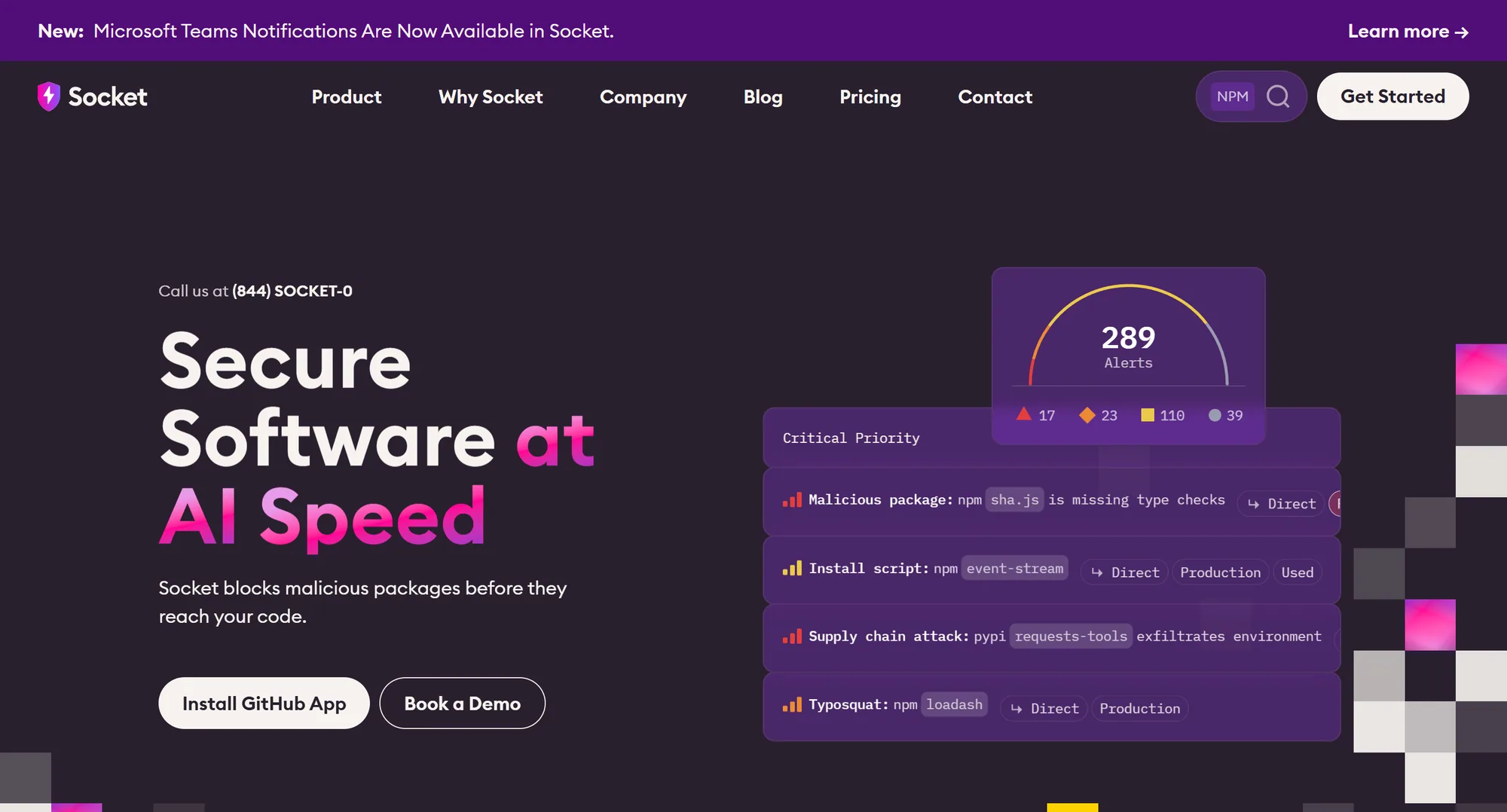
Socket is a software supply chain security company founded in 2021. It describes its product as a developer-first platform that proactively detects and blocks malicious packages in real time. Socket analyzes what open-source packages actually do: install scripts, network and filesystem access, obfuscated code, known malware and typosquats. Socket for GitHub comments on pull requests that add a risky dependency, and Socket also offers reachability analysis, with full application reachability on Enterprise.
How Socket Firewall works
Socket Firewall sits between your package manager and the registry. It blocks malicious packages at any dependency depth, including transitive ones.
- Free version: runs as a command prefix, such as
sfw npm install, with no API key. It covers npm, yarn, pnpm, pip, uv and cargo, blocks confirmed malicious packages and warns on AI-detected threats. - Enterprise version: adds a registry mode that runs as a persistent service, uses your Socket organization's policies, and adds Go, Maven, Gradle, RubyGems, Bundler and NuGet. It can also block AI-detected malware, unscanned packages and packages with CVEs.
Why teams look at alternatives
- You want one tool for more than packages. Several alternatives add SAST, secrets or container scanning to their dependency checks.
- The pricing model does not fit. As of September 2026, Socket Team is $25 per developer per month with a minimum of five developers, and Business is $50 with a minimum of 20. SBOM export starts on Business, and GitLab, Bitbucket and Azure DevOps repository integrations are on Enterprise.
- You want the block at the repository manager. Some teams prefer a gate in front of their internal registry for every consumer.
- You need a record of the build. Socket reads the manifest and lock files a project declares. It does not run your build, so it cannot record what the build fetched or limit where the job connects.
What to look for
- Where the block happens: on the developer's machine, in CI, or at the package repository.
- How malicious packages are found: behavior analysis, a curated database, or published advisories.
- Which ecosystems the blocking covers, and which need a paid plan.
- Whether you also need SAST, secrets or reachability in the same product.
- Whether you need evidence of what each release was built from.
- The pricing unit: per developer, per contributor, per plan or by quote.
The options
CRACI (our product)
What it is. A GitHub Actions-compatible CI runner. You change runs-on to
craci, and while jobs run, CRACI records every package and file they fetch from npm, PyPI, RubyGems,
Cargo, Go, Nix, OCI, apt, apk and Git sources, including packages restored from CI caches. That includes hidden
dependencies no lockfile lists, such as code downloaded by npm install hooks. Each SBOM states its completeness per
job and per cache. An egress policy, validated before the job starts, fails closed.
Where it overlaps with Socket. Both limit what a malicious package can do. CRACI does it at the network. With a default-deny egress policy, a build can reach only the sources it needs and the places it publishes to. Malware that tries to send your secrets to an attacker's host is blocked. Because the policy allows only what the build needs, it protects you even as patient zero of a new attack such as Shai-Hulud.
Consider if. Your gap is evidence of what each release was built from, or control of where builds connect. CRACI flags a malicious release only once it has a published CVE; it does not analyze or score packages, and organization-wide package blocklists are on the roadmap. It supports GitHub Actions on Linux only today, with GitLab CI and Jenkins on the roadmap. Teams that want packages screened keep Socket or another tool below for that job. CRACI vs Socket
Aikido
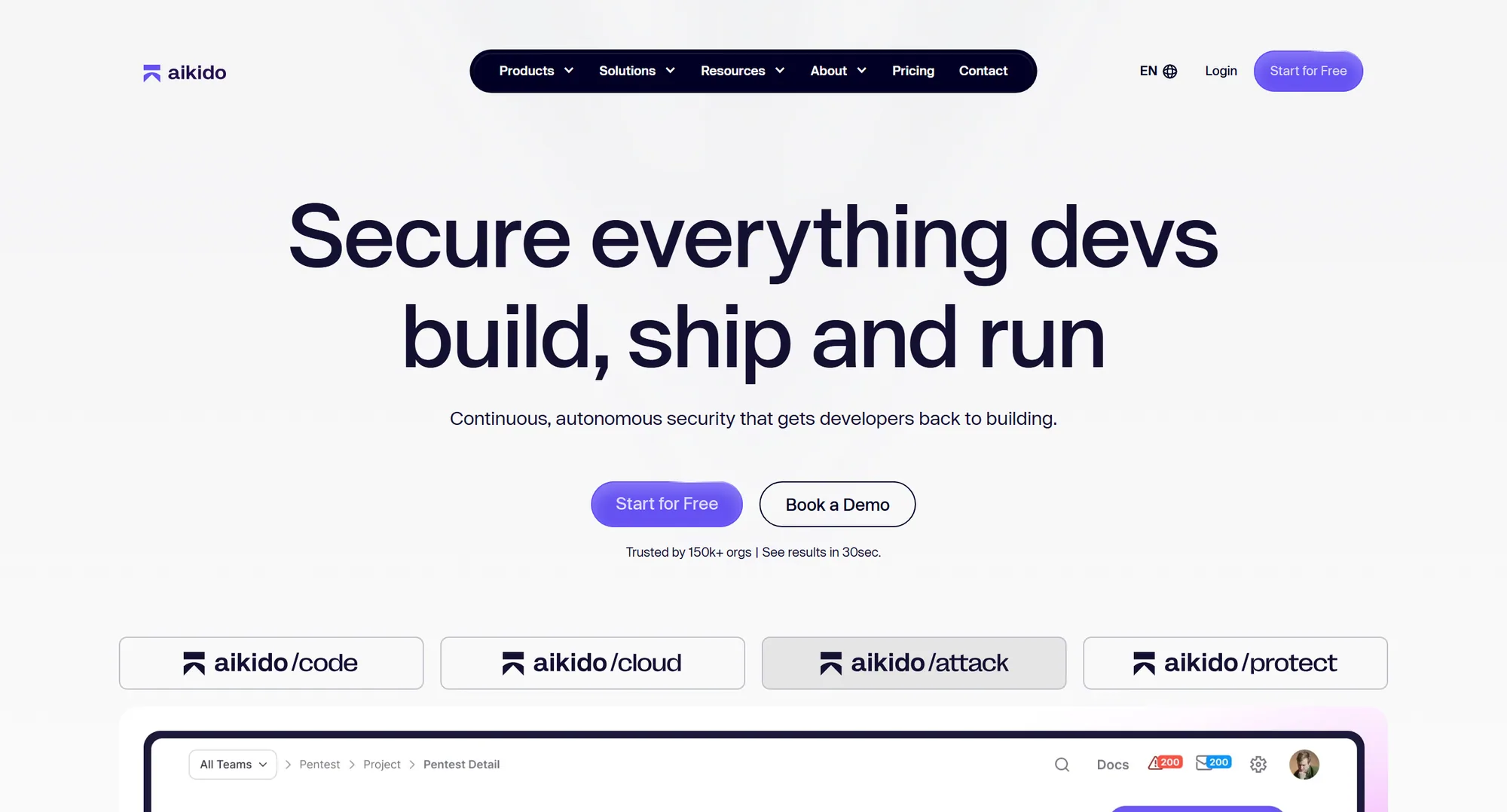
What it is. A broad AppSec suite. Every plan lists SCA, SAST, secrets, IaC, cloud posture, container scanning, DAST, license scanning and SBOM generation, and its SCA uses function-level reachability. Safe Chain, a free tool, runs a local proxy in front of npm and PyPI package managers and blocks packages with known malware before they install, locally and in CI.
Best for. Smaller teams that want one tool for most scanning, plus free malware blocking.
Consider if. You use npm and PyPI and want install-time blocking without a paid plan. There is a free Developer plan, and paid plans start at $350 per month (as of September 2026). CRACI vs Aikido
Endor Labs
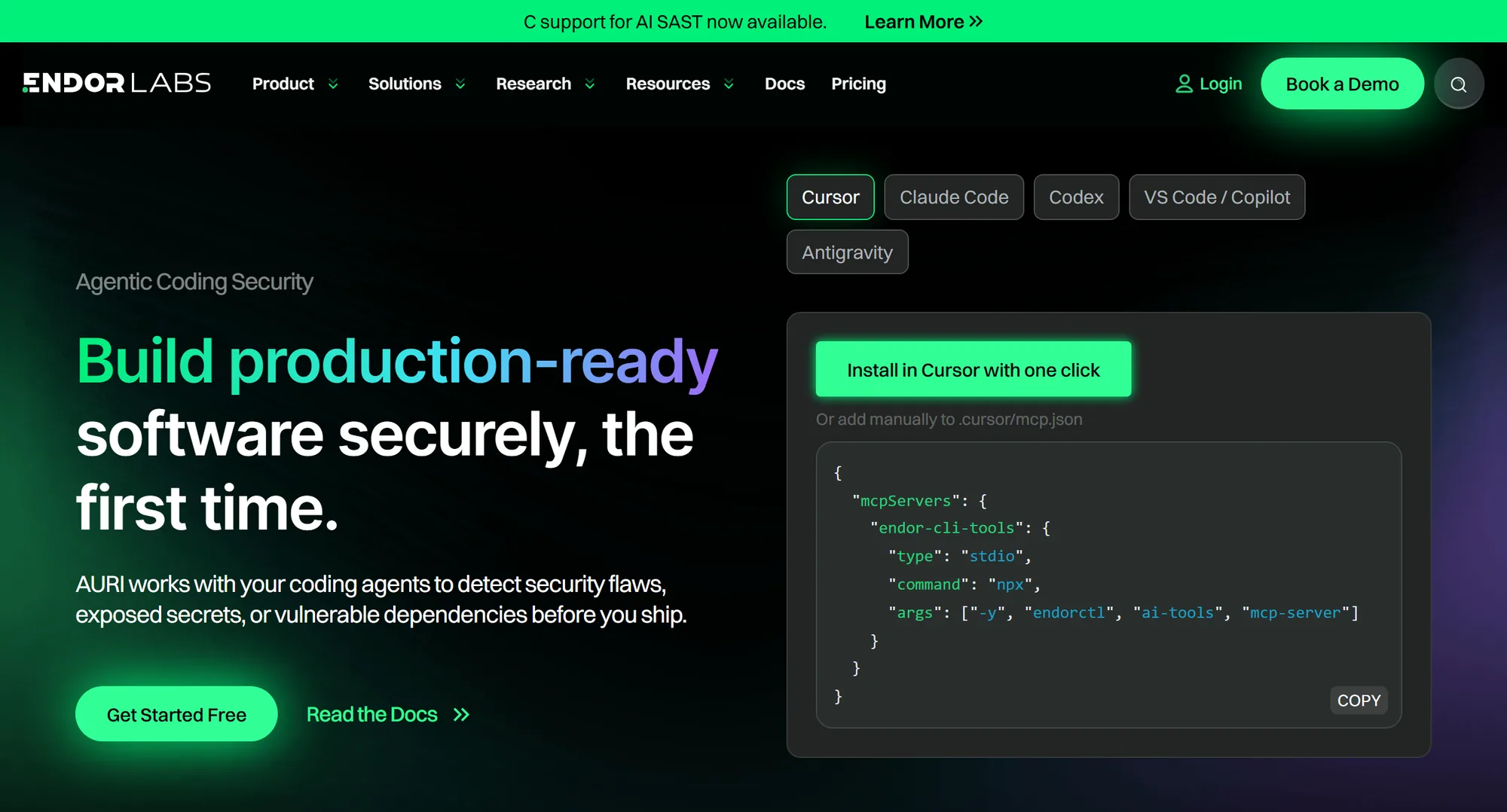
What it is. A platform built around function-level reachability for direct and transitive dependencies. It includes malicious package detection and a Package Firewall that sits as a proxy between your artifact repository and public registries, plus AI SAST, secrets and container scanning and an SBOM Hub with VEX.
Best for. Teams that want a package firewall and fewer, better-ranked dependency alerts.
Consider if. Alert volume is as much of a problem as malicious packages. It offers a free Developer tier; Core and Pro are sold per contributing developer through sales (as of September 2026). CRACI vs Endor Labs
Sonatype
What it is. An open-source governance suite. Repository Firewall blocks and quarantines components before they enter your repositories, and Firewall Pro extends that to Artifactory, Cloudsmith and GitHub Packages. Sonatype Lifecycle adds SCA and policy, self-hosted or SaaS.
Best for. Organizations that want one gate at the package repository for every team.
Consider if. You run Nexus or another repository manager. New customers buy Sonatype Guide; Firewall Pro starts at $4,800 per year (as of September 2026). CRACI vs Sonatype
Snyk
What it is. A developer security platform that runs in the IDE, the CLI, against repositories and in CI. Snyk's Security Research team tracks malicious packages published to registries such as npm, PyPI, NuGet and RubyGems, and Snyk rates them Critical. Snyk Open Source adds reachability, upgrade pull requests and license policies, and Snyk Code covers SAST.
Best for. Teams that want malicious packages flagged next to their other dependency findings.
Consider if. You want one developer-facing tool across code and dependencies. Snyk's docs do not say it blocks installs. Team starts at $25 per month (as of September 2026). CRACI vs Snyk
GitHub: Dependabot malware alerts
What it is. Dependabot checks the dependencies on your default branch against malware advisories in the GitHub Advisory Database and raises an alert with remediation steps. It covers Composer, Go, Maven, npm, NuGet, pip, RubyGems and Rust. GitHub notes that new malware may take time to appear in the database, and only advisories GitHub has reviewed trigger alerts.
Best for. Teams on GitHub that want malware alerts without adding a vendor.
Consider if. Alerts after the fact are enough for you. Dependabot alerts come with every GitHub plan, and Code Security adds CodeQL and dependency review at $30 per active committer per month (as of September 2026). CRACI vs Dependabot
Mend.io
What it is. An application security platform. Mend SCA flags typosquats, dependency confusion and packages with backdoor or data exfiltration code, traces reachability through transitive dependencies and enforces license policies. Mend SAST covers first-party code, and Mend Renovate keeps dependencies current.
Best for. Teams that want malicious package detection inside a full SCA and SAST product.
Consider if. You already use Renovate. Mend AppSec is priced at up to $1,000 per contributing developer per year (as of September 2026). CRACI vs Mend.io
Checkmarx One
What it is. A broad AppSec platform with SAST, SCA, secrets, IaC, API security, DAST, containers and malicious package protection. Checkmarx maintains a proprietary database of malicious open-source packages, covering typosquatting, dependency confusion and compromised accounts, and can block a build automatically when one appears in your dependency tree.
Best for. Organizations that want one vendor for application security testing.
Consider if. You are replacing several scanners at once. Pricing is by quote. CRACI vs Checkmarx One
Side by side
Nine products do not fit one table, so they are split in two, with CRACI and Socket in both. "Not stated" means the vendor pages we cite do not say either way. Prices are as of September 2026. For CRACI's current terms, see pricing.
Package firewalls
| Capability | CRACI | Socket | Aikido | Endor Labs | Sonatype |
|---|---|---|---|---|---|
| Runs your CI jobs | Jobs run on CRACI runners | ||||
| Malicious package detection | Package behavior analysis | Known malware | |||
| Blocks packages before they install | Package blocklists | Socket Firewall | Safe Chain, npm and PyPI | Package Firewall | Repository Firewall |
| Reachability prioritization | |||||
| SAST for your own code | Not stated | AI SAST | Not stated | ||
| Dependencies recorded from the build | Reads manifests and lock files | ||||
| Egress policy for build jobs | Default deny or allow, fails closed | Firewall filters installs | Not stated | ||
| SBOM export | Per build | Business plan and up | |||
| Pricing | Pay per build minute, no monthly fee | Free; Team $25 and Business $50 per developer/mo | Free plan; paid from $350/mo | Free tier; paid via sales | Sonatype Guide; Firewall Pro from $4,800/yr |
- Included
- Not included
- On the roadmap
Scanners that flag malicious packages
| Capability | CRACI | Socket | Snyk | GitHub | Mend.io | Checkmarx One |
|---|---|---|---|---|---|---|
| Runs your CI jobs | Jobs run on CRACI runners | |||||
| Malicious package detection | Package behavior analysis | Rated Critical | Dependabot malware alerts | Typosquats, backdoors, exfiltration code | ||
| Blocks packages before they install | Package blocklists | Socket Firewall | Not stated | Not stated | Not stated | Can block the build |
| Reachability prioritization | Not stated | |||||
| SAST for your own code | Not stated | Snyk Code | CodeQL, in Code Security | |||
| Dependencies recorded from the build | Reads manifests and lock files | Submitted build data | Uploaded source archive | |||
| Egress policy for build jobs | Default deny or allow, fails closed | Firewall filters installs | ||||
| SBOM export | Per build | Business plan and up | Enterprise plans | SPDX | ||
| Pricing | Pay per build minute, no monthly fee | Free; Team $25 and Business $50 per developer/mo | Free tier; Team from $25/mo | Dependabot on every plan; add-ons $19 and $30 per committer/mo | Up to $1,000 per contributing developer/yr | Quote |
- Included
- Partly
- Not included
- On the roadmap
When to stay with Socket
- You want package behavior analysis that can flag a malicious package before any advisory exists.
- You want risky dependencies flagged in the pull request, before they merge.
- You want install-time blocking for free across npm, yarn, pnpm, pip, uv and cargo.
- You do not need a record of what each build fetched. If you later do, CRACI can run your builds while Socket keeps checking your pull requests.
To see what a build actually reached, book a demo, or read about egress policy for GitHub Actions and build-time SBOM generation.
Socket alternatives FAQ
Short answers to the questions teams ask when they compare
What is the best alternative to Socket?
It depends on what you want Socket to do. To block malicious packages at install, look at Aikido Safe Chain, the Endor Labs Package Firewall or Sonatype Repository Firewall. For broader scanning that also flags malicious packages, look at Snyk, Mend.io or Checkmarx One. Dependabot malware alerts come from GitHub itself. If your gap is a record of what each build fetched and control over where it connects, CRACI covers that, but it does not detect malicious packages.
How does Socket Firewall work?
Socket Firewall sits between your package manager and the registry and blocks malicious packages at any dependency depth, including transitive ones. The free version runs as a command prefix, such as sfw npm install, needs no API key, and covers npm, yarn, pnpm, pip, uv and cargo. It blocks confirmed malicious packages and warns on AI-detected threats. The Enterprise version adds a registry mode that runs as a persistent service, your organization's policies, and Go, Maven, Gradle, RubyGems, Bundler and NuGet.
What type of company is Socket?
Socket is a software supply chain security company founded in 2021. It describes its product as a developer-first platform that proactively detects and blocks malicious packages in real time. Its investors include Andreessen Horowitz and Thrive Capital.
Are there free alternatives to Socket?
Yes. Aikido Safe Chain is a free tool that blocks known malware in npm and PyPI installs, locally and in CI. Dependabot malware alerts use the GitHub Advisory Database and cover Composer, Go, Maven, npm, NuGet, pip, RubyGems and Rust. Aikido and Endor Labs also have free tiers. Socket itself has a free plan and a free version of Socket Firewall.
Does CRACI detect malicious packages?
Not the way Socket does. CRACI flags a malicious release once it has a published CVE, like any other vulnerability, but it does not analyze package behavior or score packages, so it will not catch a new one before an advisory exists. It is a GitHub Actions runner that records every package a build fetched and enforces an egress policy for the job. With a default-deny policy, the build can reach only the sources it needs, so malware that tries to send your secrets to an unknown host is blocked, even in an attack nobody has seen before. Organization-wide package blocklists are on the roadmap.
Can I use Socket and CRACI together?
Yes. They work at different points. Socket screens packages in pull requests and at install. CRACI runs the build, records what it fetched, limits where it can connect and keeps tracking vulnerabilities in what shipped. Runs on CRACI still appear in GitHub, so Socket's pull request checks keep working.
See what your builds actually pulled in
Book a demo to see the SBOM, network trace and egress policy CRACI records for every GitHub Actions build.
Book a demo