Alternatives
GitHub Advanced Security alternatives
The main GitHub Advanced Security alternatives are CRACI for a record of what each GitHub Actions build actually fetched, Snyk and Semgrep for developer-facing SAST and SCA, Aikido and Checkmarx One for broad suites, Endor Labs, Mend.io and Sonatype for dependency risk, and Socket for malicious packages.
Updated
We build CRACI, so weigh that in; we describe every option from its own documentation and say when another tool fits better.
The best GitHub Advanced Security alternatives at a glance
| Capability | Best for | Pricing (September 2026) |
|---|---|---|
| CRACI | A record of what each GitHub Actions build fetched, with egress control and provenance | Pay per build minute, no monthly fee |
| Snyk | Developer-facing SAST and SCA from the IDE to the pull request | Free tier; Team from $25 per month |
| Aikido | Small teams that want one tool for most scanning | Free plan; paid from $350 per month |
| Semgrep | Customizable SAST, reachable SCA and secrets, bought one at a time | Free up to 10 contributors; Teams from $30 per contributor per month |
| Checkmarx One | One vendor for SAST, SCA, secrets, DAST, IaC and more | Quote |
| Endor Labs | Cutting dependency alert volume with reachability | Free Developer tier; paid tiers via sales |
| Mend.io | SAST and SCA from one vendor, with Renovate updates | Up to $1,000 per contributing developer per year |
| Sonatype | Policy at scale and a gate at the package repository | Sonatype Guide; Firewall Pro from $4,800 per year |
| Socket | Stopping malicious packages in pull requests and at install | Free; Team $25 and Business $50 per developer per month |
What GitHub Advanced Security includes
As of September 2026, GitHub sells Advanced Security as two add-ons. Secret Protection costs $19 per active committer per month and covers secret scanning, push protection and validity checks. Code Security costs $30 per active committer per month and covers CodeQL code scanning, Copilot Autofix, dependency review and premium Dependabot features. Both need a GitHub Team or Enterprise plan. They build on the dependency graph and Dependabot alerts, which every GitHub plan includes.
Teams look at alternatives for a few reasons:
- Cost. Both add-ons come to $49 per active committer per month, on top of GitHub seats. A team of 50 committers pays $2,450 a month, or $29,400 a year, at list price.
- Reach. GitHub Advanced Security works on GitHub, and on Azure Repos through its Azure DevOps version. Several alternatives also cover GitLab, Bitbucket and other CI systems.
- Noise. Several alternatives use reachability analysis to check whether your code can call a vulnerable function before a finding reaches a developer.
- Evidence of the build. Every GitHub Advanced Security feature reads your repository. None of it records what the build that produced your release fetched, or controls where that build can connect.
What it costs compared with the alternatives
The pricing units differ, so compare the unit before the number. GitHub counts active committers: anyone whose commit was pushed to an enabled repository in the last 90 days, counted once across your organization. Most alternatives count contributing developers or contributors, and some price per plan.
| Capability | Priced by | Published price (September 2026) |
|---|---|---|
| GitHub Advanced Security | Active committer, per product | Secret Protection $19 and Code Security $30 per active committer per month; $49 for both, on Team or Enterprise |
| Snyk | Contributing developer | Free tier; Team from $25 per month; Enterprise by quote |
| Semgrep | Contributor, per product | Free up to 10 contributors and 10 repositories; Teams $30 per contributor per month for Code or Supply Chain, $15 for Secrets |
| Aikido | Plan | Free Developer plan; paid plans from $350 per month |
| Checkmarx One | Quote | Not published |
| Endor Labs | Contributing developer | Free Developer tier; Core and Pro through sales |
| Mend.io | Contributing developer | Mend AppSec up to $1,000 per year |
| Sonatype | Product | Sonatype Guide for new customers; Firewall Pro from $4,800 per year |
| Socket | Developer | Free plan; Team $25 (minimum five) and Business $50 (minimum 20) per month; Enterprise custom |
| CRACI | Build minutes | $0.002 per vCPU-minute ($0.004 for 2 vCPU), metered per second; no monthly fee |
Prices are each vendor's published list prices as of September 2026. CRACI's price includes the runner minutes that replace GitHub-hosted runner minutes, and it does not include SAST or secrets scanning, so it is not a like-for-like swap. See CRACI pricing and GitHub Advanced Security pricing for how GitHub bills.
What to look for
- Whether you need SAST, secrets and SCA from one vendor or can buy them separately.
- How findings are prioritized: reachability, EPSS, exploit data.
- Which source control and CI systems you need supported.
- Where the dependency list comes from: manifests, source analysis, or the build itself.
- Whether you must prove what each release was built from, for customers or regulators.
- The pricing unit, and who counts toward it.
The options
CRACI (our product)
What it is. A GitHub Actions-compatible CI runner. You change runs-on to
craci, and while jobs run, CRACI records every external dependency they fetch, including packages
restored from CI caches, and exports the SBOM as CycloneDX or SPDX with a completeness state per job and per
cache. A dependency graph shows each SBOM's dependency layers. CRACI enforces an egress policy that fails
closed, keeps re-evaluating monitored SBOMs, and can block a
build on policy findings, including a specific CVE. CRACI has found vulnerable packages that Snyk and Aikido did
not report, because their scans were missing the components.
What it does not do. CRACI does no SAST and no secrets scanning, by design. Plenty of excellent SAST tools work alongside it, including the ones below. It supports GitHub Actions on Linux only today, with GitLab CI and Jenkins on the roadmap. CRACI is hosted in Europe.
Consider if. You keep a SAST tool and need evidence of what each release was built from. Runs on CRACI still appear in GitHub. CRACI and GitHub Advanced Security
Snyk
What it is. A developer security platform that runs in the IDE, the CLI, against repositories and in CI. Snyk Open Source prioritizes dependency findings with reachability, exploit maturity, EPSS and CVSS and opens upgrade pull requests. Snyk Code covers SAST, and Snyk Container and Snyk Infrastructure as Code extend it to images and IaC.
Best for. Teams that want security feedback where developers work, across several platforms.
Consider if. You want reachability and more than one CI system. Snyk has Team from $25 per month for up to 10 developers and Enterprise by quote. The snyk sbom
command is Enterprise only (as of September 2026). CRACI vs Snyk
Aikido
What it is. A broad AppSec suite. Every plan lists SCA, SAST, secrets, IaC, cloud posture, container scanning, DAST, license scanning and SBOM generation. Its SCA uses function-level reachability, AutoFix opens pull requests, and it can block pull requests with critical findings.
Best for. Smaller teams that want one tool and one dashboard for most scanning needs.
Consider if. Consolidation is the goal. There is a free Developer plan, and paid plans start at $350 per month (as of September 2026). CRACI vs Aikido
Semgrep
What it is. An AppSec platform with three products: Semgrep Code for SAST, Semgrep Supply Chain for SCA, and Semgrep Secrets. Supply Chain classifies findings as reachable, conditionally reachable or unreachable, and Semgrep says this reduces false positives by up to 98%. It exports CycloneDX SBOMs and runs in GitHub Actions, GitLab CI/CD, Jenkins, Bitbucket, CircleCI, Buildkite, Azure Pipelines and Semaphore.
Best for. Teams that want to write their own SAST rules and pair them with reachable SCA.
Consider if. You want to buy products one at a time. The free plan covers up to 10 contributors and 10 repositories; Teams starts at $30 per contributor per month for Code or Supply Chain and $15 for Secrets (as of September 2026).
Checkmarx One
What it is. A broad AppSec platform: SAST, SCA, secrets, IaC, API security, DAST, containers and malicious package protection, with a posture management layer on top. Its SCA uses exploitable path analysis, and policies can break builds. It has plugins for many CI systems, GitHub Actions among them.
Best for. Organizations that want one vendor for application security testing.
Consider if. You want to replace GitHub Advanced Security and a DAST tool with one contract. Pricing is by quote. CRACI vs Checkmarx One
Endor Labs
What it is. A platform built around function-level reachability for direct and transitive dependencies, which Endor Labs says cuts SCA findings by 92%. It adds upgrade impact analysis, Endor Patches that backport fixes, AI SAST, secrets and container scanning, a Package Firewall, artifact signing and an SBOM Hub with VEX.
Best for. Teams whose main problem is the volume of Dependabot alerts.
Consider if. You want fewer, better-ranked dependency findings. It offers a free Developer tier; Core and Pro are sold per contributing developer through sales (as of September 2026). CRACI vs Endor Labs
Mend.io
What it is. An application security platform. Mend AppSec combines Mend SAST with Mend SCA, which traces reachability through transitive dependencies, enforces license policies and flags malicious packages. Mend Renovate keeps dependencies current across 90+ package managers.
Best for. SAST, SCA and automated updates from one vendor.
Consider if. You already use Renovate. Mend AppSec is priced at up to $1,000 per contributing developer per year (as of September 2026). CRACI vs Mend.io
Sonatype
What it is. An open-source governance suite. Sonatype Lifecycle is its SCA and policy product, self-hosted or SaaS, and Repository Firewall blocks and quarantines components before they enter your repositories. Lifecycle analyzes the built application with Advanced Binary Fingerprinting.
Best for. Organizations that want dependency policy at scale and a gate at the repository.
Consider if. Dependencies are your main concern and you run a repository manager. New customers buy Sonatype Guide; Firewall Pro starts at $4,800 per year (as of September 2026). CRACI vs Sonatype
Socket
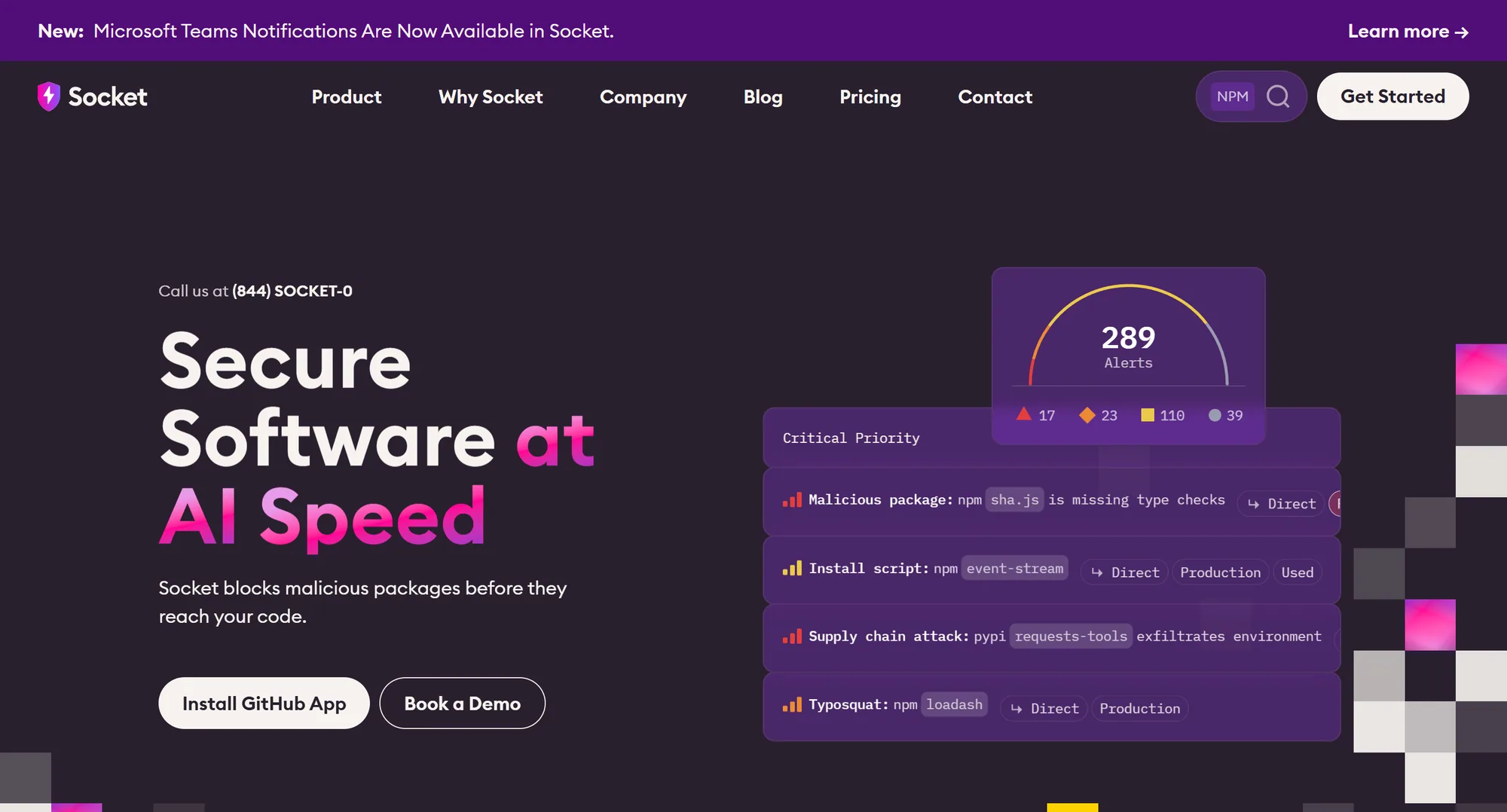
What it is. A platform that analyzes how open-source packages behave: install scripts, network and filesystem access, obfuscated code, known malware and typosquats. It flags risky additions in pull requests, Socket Firewall blocks malicious packages at install time, and it offers reachability analysis.
Best for. Stopping malicious packages, including ones with no advisory yet.
Consider if. Malicious packages worry you more than known CVEs. Socket has a free plan; Team is $25 and Business $50 per developer per month (as of September 2026). Socket alternatives
Side by side
Ten products do not fit one table, so they are split in two, with CRACI and GitHub Advanced Security in both. "Not stated" means the vendor pages we cite do not say either way. Prices are as of September 2026.
Broad AppSec suites
| Capability | CRACI | GitHub Advanced Security | Snyk | Aikido | Checkmarx One | Semgrep |
|---|---|---|---|---|---|---|
| SAST for your own code | CodeQL, in Code Security | Snyk Code | Semgrep Code | |||
| Secrets scanning | Secret Protection | Not stated | Semgrep Secrets | |||
| Dependency vulnerability alerts | Monitored SBOMs re-evaluated | Dependabot | Semgrep Supply Chain | |||
| Reachability prioritization | Not stated | |||||
| Runs your CI jobs | Jobs run on CRACI runners | |||||
| Dependencies recorded from the build | Submitted build data | Uploaded source archive | ||||
| Egress policy for build jobs | Default deny or allow, fails closed | Not stated | ||||
| Signed build provenance | No signed provenance | Artifact attestations | Not stated | Not stated | Not stated | Not stated |
| CI beyond GitHub Actions | GitLab CI and Jenkins | Not stated | ||||
| Pricing | Pay per build minute, no monthly fee | $19 and $30 per active committer/mo | Free tier; Team from $25/mo | Free plan; paid from $350/mo | Quote | Free up to 10 contributors; Teams from $30 per contributor/mo |
- Included
- Partly
- Not included
- On the roadmap
Dependency and package tools
| Capability | CRACI | GitHub Advanced Security | Endor Labs | Mend.io | Sonatype | Socket |
|---|---|---|---|---|---|---|
| SAST for your own code | CodeQL, in Code Security | AI SAST | Not stated | Not stated | ||
| Secrets scanning | Secret Protection | Not stated | Not stated | Not stated | ||
| Dependency vulnerability alerts | Monitored SBOMs re-evaluated | Dependabot | ||||
| Reachability prioritization | Not stated | |||||
| Runs your CI jobs | Jobs run on CRACI runners | |||||
| Dependencies recorded from the build | Submitted build data | |||||
| Egress policy for build jobs | Default deny or allow, fails closed | Firewall filters installs | ||||
| Signed build provenance | No signed provenance | Artifact attestations | Artifact signing | Not stated | Not stated | Not stated |
| CI beyond GitHub Actions | GitLab CI and Jenkins | Not stated | ||||
| Pricing | Pay per build minute, no monthly fee | $19 and $30 per active committer/mo | Free tier; paid via sales | Up to $1,000 per contributing developer/yr | Sonatype Guide; Firewall Pro from $4,800/yr | Free; Team $25 and Business $50 per developer/mo |
- Included
- Partly
- Not included
- On the roadmap
When to stay with GitHub Advanced Security
- Your code and workflows live on GitHub, and you want security results inside pull requests there.
- CodeQL, push protection and Dependabot cover what you need.
- Your repositories are public, where much of it is free.
- You want fewer vendors, and per-committer pricing suits your team.
Whichever scanner you choose, book a demo to see what CRACI records for a GitHub Actions build, or read about build-time SBOM generation.
GitHub Advanced Security alternatives FAQ
Short answers to the questions teams ask when they compare
Is GitHub Advanced Security free?
Partly. On public repositories GitHub enables code scanning, secret scanning and push protection by default, and dependency review is free too. The dependency graph and Dependabot alerts are included in every GitHub plan. Private repositories need the paid add-ons: as of September 2026, Secret Protection is $19 and Code Security $30 per active committer per month, on a GitHub Team or Enterprise plan.
What is the best alternative to GitHub Advanced Security?
It depends on why you are leaving. For developer-facing SAST and SCA, look at Snyk or Semgrep. For one broad suite, look at Aikido or Checkmarx One. To cut dependency alert volume, look at Endor Labs, and for a gate at the package repository, Sonatype. Socket focuses on malicious packages. None of these runs your build. If the gap is a record of what each release was built from, CRACI adds that, but it does no SAST or secrets scanning.
What are the key differences between GitHub Advanced Security and Snyk?
GitHub Advanced Security lives inside GitHub: CodeQL code scanning, secret scanning with push protection, and dependency review, priced per active committer at $19 and $30 per month. Snyk runs in the IDE, the CLI, against repositories and in many CI systems, adds reachability to its dependency findings, and has a Team plan from $25 per month. Snyk's SBOM command needs an Enterprise plan; GitHub exports the dependency graph as SPDX on every plan.
Which alternatives cover both SAST and secrets scanning?
On this page, Aikido, Checkmarx One, Semgrep and Endor Labs cover both SAST and secrets. Snyk and Mend.io cover SAST; the pages we cite do not describe secrets scanning. CRACI covers neither: it is a runner that records builds, and it works alongside the SAST tool you choose.
Is there a cheaper alternative to GitHub Advanced Security?
It depends on team size and which products you need. Semgrep is free for up to 10 contributors, and Aikido, Endor Labs and Socket have free tiers. Per-seat prices are close: Semgrep Teams is $30 per contributor per month for Code, against $30 per active committer for GitHub Code Security. Count who actually commits, and which products you would buy, before you compare.
Does CRACI replace GitHub Advanced Security?
No. CRACI does no code scanning or secret scanning. It replaces the runner your GitHub Actions jobs run on, records what each build fetched and enforces an egress policy. Teams keep GitHub Advanced Security or another SAST tool for their code and add CRACI for evidence of what they built.
Keep your scanner. Add evidence from every build.
Book a demo to see the SBOM and egress policy CRACI records for a GitHub Actions build.
Book a demo